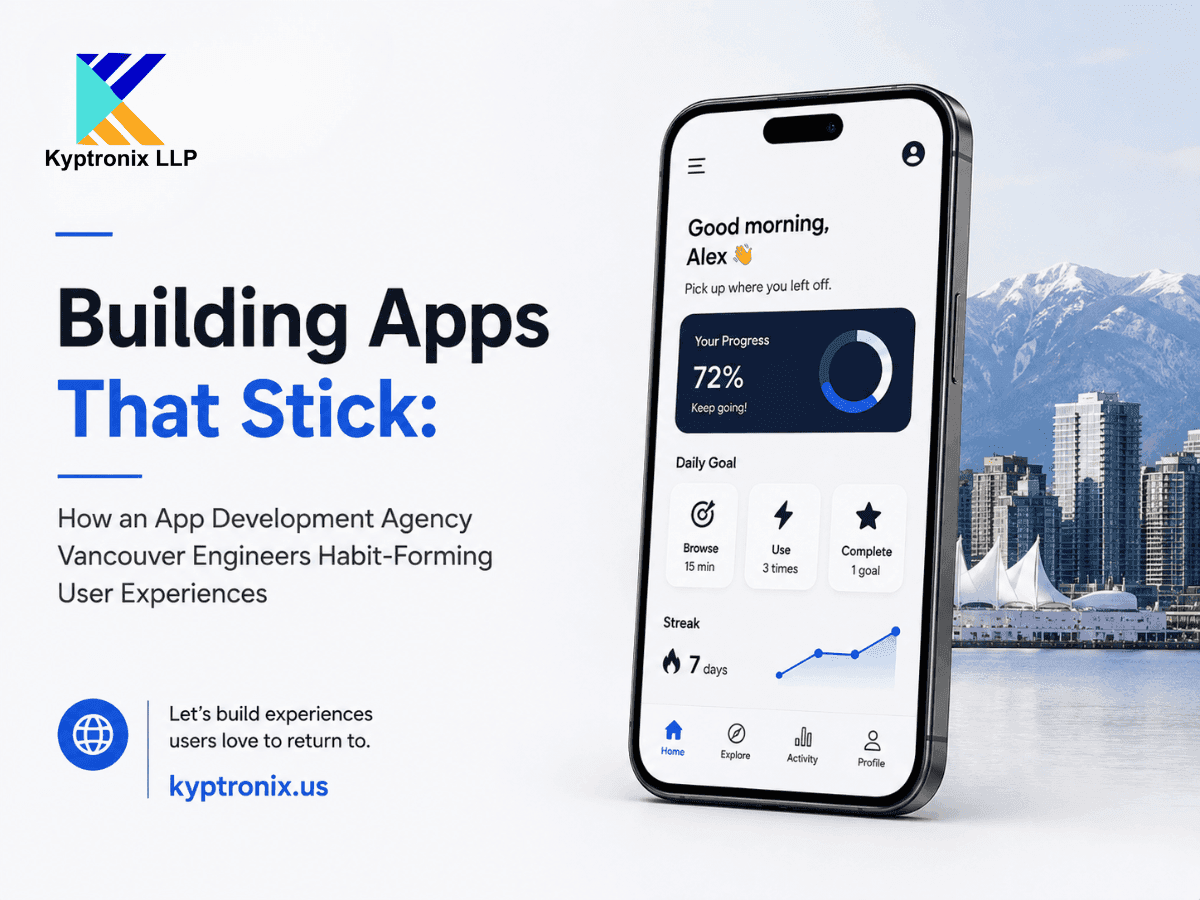
Building a custom mobile app is a real investment; nobody writes that check lightly. And yet most apps quietly die before they ever turn a profit. The numbers on this aren't subtle: most apps lose the bulk of their active users within thirty days of someone hitting install. Marketing gets people through the door. Getting them to come back tomorrow and the day after that is the part almost nobody gets right.
That's why US organizations increasingly end up working with an experienced App Development Agency Vancouver teams already know and trust. Vancouver's tech scene has a good mix going for it: strong engineering talent, easy cross-border alignment, product strategy that's actually been battle-tested. But none of that matters if the team stops at surface-level features. Real habit-forming UX design has to be part of the build from day one, not something sprinkled on at the end.
The Retention Crisis: Why Downloads Are a Vanity Metric
Getting a user costs money. Keeping one is what actually builds value over time - real, compounding value. When teams chase downloads instead of building out solid user retention strategies, they're pouring marketing dollars into something that leaks.
Picture two paths. One: heavy ad spend, a pile of downloads, and then more than 70% of those users are gone within a month. Two: guided onboarding that builds real habits, which leads to higher lifetime value and growth that doesn't need constant ad spend to keep going.
That 70% churn number isn't an outlier, either; it's roughly the industry norm across most categories. And the reasons people bail tend to repeat themselves: the app's confusing to learn, it's slow, the notifications feel like nagging, or there's just no obvious payoff for opening it. Getting past that wall means weaving behavioral psychology into development itself, not tacking it on after the fact.
Engineering Habit-Forming UX: The Science of Digital Retention
Getting someone to open an app every day isn't luck. It takes a real framework. Instead of leaning on push notifications that feel like nagging, a good team builds quieter feedback loops, the kind that make coming back feel natural instead of forced.
There are roughly four moving pieces to a solid custom mobile app development approach here, and they work together:
Contextual triggers come first: small, well-timed prompts that gradually attach themselves to something the user already wants, whether that's efficiency, a sense of order, or just connection. Then there's frictionless action: workflows built so people can get things done with barely any effort or mental load. Variable rewards keep things interesting without wearing anyone out: fresh data, visible progress, a milestone hit. And user investment closes the loop: once someone's stored data or set preferences inside your app, leaving starts to feel like a real cost, not a shrug.
We saw this play out firsthand during an audit of an enterprise workflow tool a while back. People were dropping off hard right at onboarding; the app demanded eight profile fields before anyone could even see the dashboard. So we rebuilt it around progressive disclosure and better app engagement mechanics. Instead of front-loading all that data, we let people go straight into the core tools and only asked for profile info when a specific task actually called for it. Once that new flow went live, 30-day retention climbed, and time-to-first-value dropped noticeably faster than we'd expected.
Core Architectural Pillars for Sustainable Retention
High-retention software needs the frontend and backend to actually work together, not pull in different directions. When US businesses go looking for mobile app development Vancouver partners, what they're really after is a team that can handle both the architecture side and the design side well, not just one or the other.
Frictionless onboarding, a UI that responds
First impressions set the tone for everything after. The apps that keep people around tend to walk them through small, intuitive steps instead of dumping a wall of tutorial text on them. Good UI/UX design Vancouver work means every button, every loading animation, every screen transition gives some kind of feedback; the user always has a sense that something's happening, even in the smallest interactions.
Personalization that actually predicts something
People expect apps to understand context now, not just react to taps. Real-time analytics paired with predictive logic lets an app get ahead of what someone needs based on past behavior, where they are, or what time it is. Surface the right shortcut at the right moment, and day-30 and day-90 retention both tend to move.
Cross-border engineering that isn't a hassle
Working with a Vancouver-based team means US companies collaborate in the same or an adjacent time zone, PST, while still tapping into a genuinely deep North American engineering pool. No 12-hour lag waiting on a Slack reply.
Acquisition-First vs. Retention-First: What Actually Changes
These two approaches don't just feel different; they measure different things entirely. Acquisition-first chases total downloads and installs. Retention-first tracks daily active users and lifetime value instead, which tells you a lot more about whether the business is actually healthy.
Onboarding looks different too. Acquisition-first tends to front-load data collection right at the start; retention-first spreads that out and gets people to real value fast. One leans on generic batch push notifications blasted to everyone; the other triggers prompts based on actual behavior. One chases visual novelty; the other chases low-friction tasks and feedback loops that build habits. And financially, it shows one path means rising acquisition costs and fast drop-off; the other means compounding organic growth and ROI that actually holds up over time.
Turn Casual Installs into Dedicated Active Users
A mobile product that actually works takes more than clean code and polished screens; that part's almost the easy half. It takes a real strategy for habit formation, ongoing utility, and low-friction engagement built in from the start. Get retention mechanics into the roadmap early, and you turn one-time downloaders into people who stick around and, eventually, people who tell their friends.
At Kyptronix US, we combine product strategy with hands-on technical execution to build web and mobile software that actually moves the needle, not just software that looks good in a pitch deck.
Schedule a Product Strategy Session with Kyptronix today.
Frequently Asked Questions
Why is retention a more critical metric than total app downloads? Downloads tell you about reach. Retention tells you whether the business actually holds up. A huge download number means very little if everyone leaves right away. Keeping people active is what lowers acquisition cost and raises lifetime value.
How does a top App Development Agency in Vancouver build habit-forming applications?
Good agencies mix behavioral psychology into agile engineering rather than treating them as separate disciplines: contextual triggers, less friction on core tasks, onboarding that unfolds gradually instead of all at once, feedback loops that make daily use feel like second nature.
What counts as a healthy 30-day mobile app retention rate?
It moves around by industry, but 15% to 25% is a rough average. The strongest apps in fintech and business productivity, categories like that, often push past 35% through steady, ongoing tuning rather than one big fix.
How is habit-forming UX design different from manipulative design?
Habit-forming UX is built around real utility; it helps people get something done faster or easier, plain and simple. Dark patterns trick people into actions they didn't mean to take. That erodes trust fast, and ironically, it speeds up churn instead of preventing it.
What role do app engagement mechanics play during onboarding?
Things like interactive tooltips, progress bars, and small early wins keep people engaged while they're still figuring things out. Get someone to a real first win quickly, and drop-off during that first session falls off noticeably.
Why do US companies choose Vancouver for custom software work?
It's a legitimately strong tech hub; it shares time zones with major US business centers; cross-border IP protections hold up well, and there's real access to engineers who've actually shipped enterprise-grade software before, not just talked about it.
How do modern retention strategies use predictive personalization?
By reading past behavior, usage timing, preference patterns, and surfacing the right tool or shortcut before someone has to go hunting for it. Done well, it makes the app feel less like software and more like something that just gets you.
What impact does frontend performance have on retention?
More than most people assume. Even small delays cause frustration. Fast load times, smooth transitions, solid offline handling — all of it keeps people from bailing mid-session out of pure impatience.
How does progressive profiling improve activation rates?
It spreads data requests out across the experience instead of dumping a long form on someone up front. Less friction at the start, faster path to real value.
How often should product teams update retention features?
Retention cohorts deserve continuous tracking, honestly, not a quarterly check-in. Most teams end up shipping small UX refinements, feature tweaks, and onboarding adjustments every two to four weeks, based on what the behavior data is actually telling them.