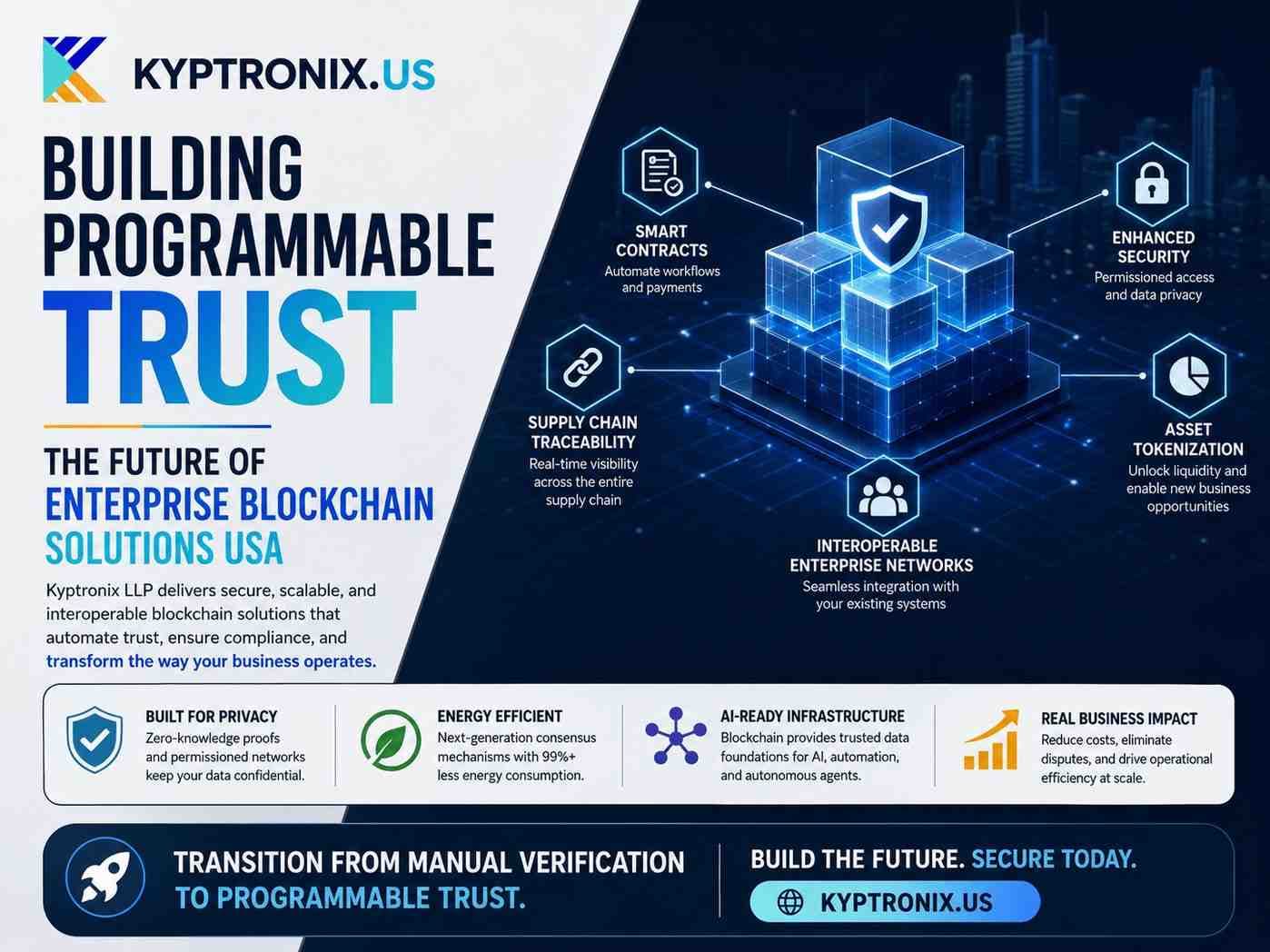
The era of viewing blockchain as a purely speculative technology is officially over. As we navigate through 2026, the technology has caught up with the promise, transitioning from theoretical pilots to mission-critical, live production environments. Today, forward-thinking organizations evaluate blockchain not for experimentation, but for immediate operational value and long-term competitive positioning.
For American businesses, adopting enterprise blockchain solutions usa is fundamentally about building "programmable trust". It is about embedding strict compliance rules directly into code, slashing dispute risks, and synchronizing critical data across fragmented corporate ecosystems. At Kyptronix LLP, we architect sophisticated, enterprise-grade distributed ledgers designed to eliminate operational friction. Here is a deep dive into how modern blockchain architecture is revolutionizing corporate infrastructure in 2026.
Moving Beyond Public Networks: The Hybrid Enterprise Reality
Early discussions around distributed ledgers were heavily dominated by public networks and energy-draining proof-of-work consensus models. Modern enterprises, however, require strict data privacy, regulatory compliance, and massive scalability.
Permissioned and Hybrid Architectures: In 2026, organizations overwhelmingly favor permissioned, consortium, or hybrid blockchain architectures. These closed networks allow verified participants to share data securely without exposing proprietary business information to the public internet.
Energy Efficiency: Next-generation consensus mechanisms, such as Byzantine Fault Tolerant models, are drastically faster and highly sustainable. In fact, future blockchains reduce energy consumption by more than 99% compared to traditional Proof of Work systems.
Interoperability: Enterprises operate across complex ecosystems, making it critical to utilize protocols that allow different blockchain frameworks to communicate flawlessly with one another.
Core Enterprise Use Cases Transforming Business
Blockchain technology in 2026 plugs directly into existing business operations to cut costs and autonomously drive workflows.
Smart Contracts and Automated Workflows
Enterprises run on vendor contracts, strict payment terms, and compliance rules. Smart contracts embed these exact rules directly into autonomous code.
Payments release automatically the moment goods arrive and are validated.
This creates a frictionless B2B relationship, heavily reducing reconciliation time and mitigating dispute risk.
"Therefore, organizations move from reactive auditing to continuous verification. That shift matters. It reduces fraud risk. It improves transparency. It strengthens internal controls. Instead of asking what went wrong three months later, enterprises can monitor data flows instantly."
Supply Chain Traceability
Supply chain transformation has evolved from simply tracking packages to facilitating autonomous global coordination.
Distributed ledgers synchronize inventory updates, shipment statuses, and compliance certificates in near real-time across multi-tier suppliers.
When integrated with IoT, smart sensors can automatically log shipment conditions directly onto the blockchain, severely reducing the chances of fraudulent transactions.
Asset Tokenization
The tokenization of real-world assets (RWAs) is a dominating trend in 2026. Property titles, corporate bonds, and carbon credits are now being represented digitally on blockchain networks. This technical transition unlocks fractional ownership and significantly accelerates the efficiency of ownership transfers.
The Intersection of Blockchain and Artificial Intelligence
One of the most profound technological shifts currently underway is the deep integration of blockchain with artificial intelligence.
Blockchain provides a trustworthy, tamper-proof, and transparent base for AI models to access and securely verify data.
Enterprises deploy blockchain provenance protocols to trace intellectual property rights, verify AI content, and detect deepfakes.
Autonomous AI agents can even utilize blockchain rails to execute instant, frictionless micropayments for API access or compute time entirely without human intervention.
Why Partner with Kyptronix LLP?
Integrating decades-old legacy IT systems with modern distributed ledgers is a highly complex engineering challenge. It requires deep, specialized expertise in cryptography, cloud architecture, and regulatory frameworks.
At Kyptronix LLP, we specialize in delivering tailored, secure enterprise blockchain solutions usa. We do not build isolated networks; we engineer robust, interoperable protocols that communicate flawlessly with your existing enterprise software. From zero-knowledge proofs that protect data privacy to automated smart contracts that streamline global logistics, we build the resilient infrastructure your company needs to dominate the digital economy.
Are you ready to transition from manual verification to programmable trust? Connect with the blockchain architects at Kyptronix LLP today to discover how distributed ledger technology can revolutionize your operational efficiency.
Frequently Asked Questions (FAQs)
1. Is enterprise blockchain secure for confidential business data?
Yes. Unlike public networks where all data is visible, enterprise solutions utilize permissioned architectures and zero-knowledge proofs. This ensures that transaction privacy is completely maintained without sacrificing transparency among verified network participants.
2. How do smart contracts actually save a business money?
Smart contracts automate business logic and compliance rules directly within the code. By removing intermediaries and automating processes like payment releases upon delivery confirmation, companies drastically lower administrative overhead and dispute resolution costs.
3. Do we need to replace our entire IT system to implement blockchain?
No. Modern enterprise blockchain solutions usa are designed to integrate with existing IT infrastructure. We build custom APIs and middleware that allow distributed ledgers to communicate efficiently with your current, decades-old ERP or CRM systems.
4. What industries are currently adopting enterprise blockchain the fastest?
While finance and supply chain logistics lead the charge, sectors like healthcare (for securing patient data), retail (for transparent loyalty programs), and real estate (for title management and fractional ownership) are rapidly deploying production-scale blockchain environments in 2026.