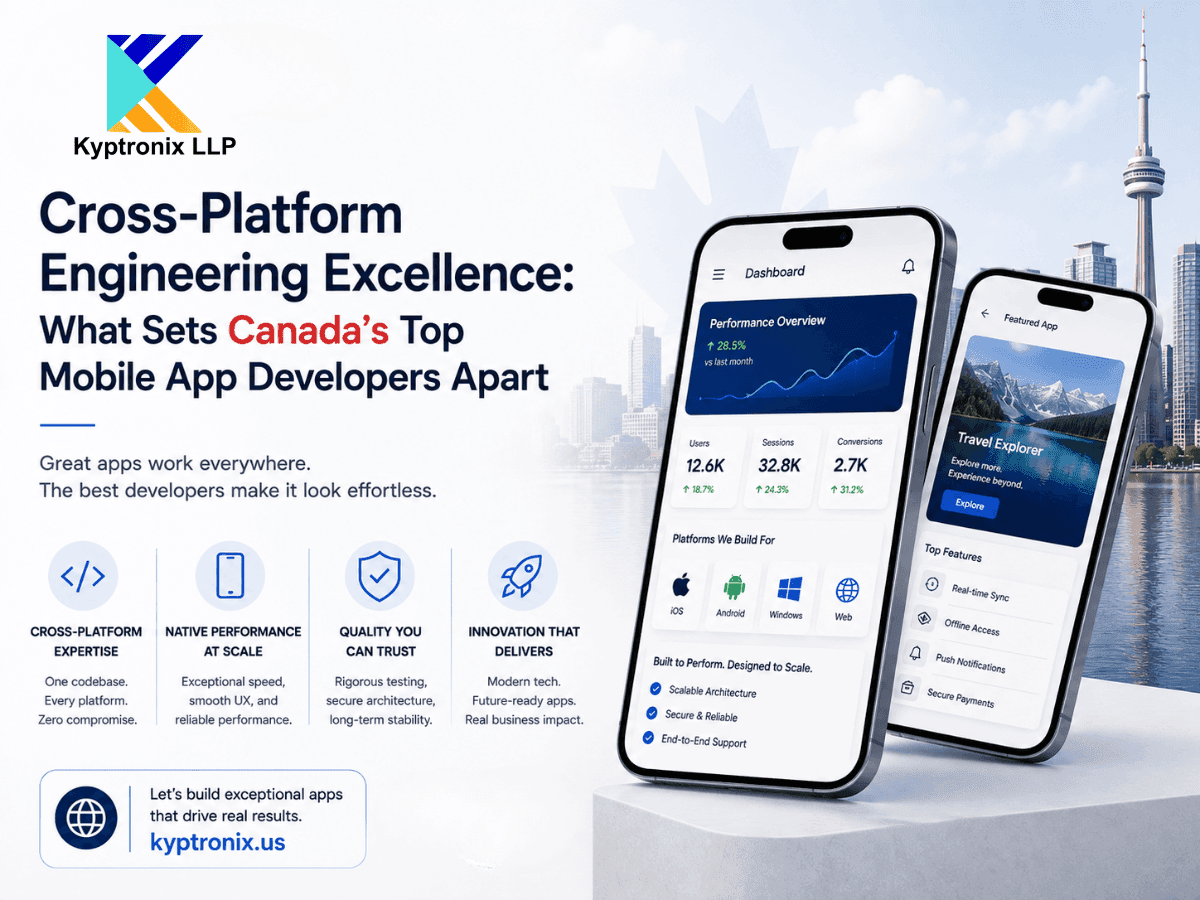
Canada's digital economy isn't waiting around. Toronto's financial firms, Vancouver's tech scene, Montreal's AI ecosystem , they're all pushing for the same thing: mobile apps that reach users fast, without the cost of building separate iOS and Android codebases from scratch.
That used to mean compromise. Cross-platform development had a reputation for feeling a little off , laggy animations, weaker offline security, hardware that never quite performed like native. Not anymore.
The bar has moved. Sub-second load times, smooth 60 FPS animation, bank-level data protection , all achievable across platforms, provided the team behind it actually understands the architecture rather than just the framework's marketing pitch.
Finding the right development partner in Canada means finding people who know both the technical internals and the regulatory landscape. At Kyptronix, that combination , engineering rigor plus strict data governance , is the whole approach.
What's Actually Happening Under the Hood
Enterprise-grade cross-platform apps live or die on framework choice, and in practice that comes down to React Native or Flutter.
The difference isn't cosmetic. React Native's Fabric architecture runs on JSI , a direct C++ bridge between JavaScript and native modules, which does away with the old bridge bottleneck and lets you tap into device hardware fast, with native OS controls intact. Flutter takes a different route entirely: its Impeller engine skips native UI components and renders straight to a canvas using metal-accelerated graphics, which is why Flutter apps look pixel-identical no matter the screen or OS.
So which one's right? It depends on what you're building. Need deep integration with Apple Pay, Android biometrics, or system-level accessibility features? React Native handles that more smoothly. Need custom data visualization, heavy canvas animation, or UI that looks exactly the same on every device? Flutter tends to hold up better.
One thing we'd push back on: don't pick a framework because it's trending. Test real thread utilization and memory consumption during your prototype phase , that's what actually tells you whether a framework fits your roadmap, not a blog post ranking.
Data Sovereignty Isn't Optional in Canada
Building for Canadian users means building compliance into the architecture from the start, not bolting it on later.
Under PIPEDA, commercial apps need explicit consent flows, real data minimization, and working DSAR (data subject access request) tools, not just a privacy policy nobody reads. Quebec's Law 25 goes further, requiring formal Privacy Impact Assessments and built-in data erasure capabilities.
For regulated industries , healthcare, legal, finance , data residency usually isn't negotiable either. That typically means hosting in-region: AWS's ca-central-1 in Montreal, or Azure Canada Central. And anything sensitive cached locally on a device needs hardware-backed encryption , iOS Keychain, Android Keystore with AES-256 GCM, no exceptions.
Here's something we've seen firsthand: in third-party security audits of PIPEDA-compliant apps, well over half the compliance flags trace back to unvetted analytics SDKs quietly sending data in the background. It's rarely the app's own code that's the problem; it's what got bundled in without a proper audit.
Where Performance Actually Breaks Down
Slow apps get deleted. Industry data puts the number at roughly 19% of uninstalls tied directly to poor performance, not features, not design, just speed.
Keeping things at 60 FPS comes down to a handful of disciplines, applied consistently rather than as an afterthought: heavy work — parsing, encryption, image processing , gets moved off the main UI thread so the interface never stutters. Lifecycle management stays strict, so image caches get cleared and listeners get unbound before they turn into memory leaks during long sessions. And payloads stay lean , paginated GraphQL, Protobuf where it makes sense , so the app still performs on a spotty 4G connection, not just on office wifi.
None of this is exotic. It's just consistently applied, sprint after sprint, instead of patched in after launch.
Choosing a Partner
A strong mobile product needs more than code , it needs a team that treats architecture, compliance, and performance as one connected problem, not three separate checklists.
At Kyptronix US, that's the lens we bring to every build, whether it's a new product or a legacy system that needs to scale. If you're evaluating partners for a Canadian mobile build, our App Development Services and broader Digital Solutions pages go into more depth.
Frequently Asked Questions
1. What makes cross-platform mobile development a smart choice for Canadian businesses?
Cross-platform development allows you to deploy fully functional apps on both iOS and Android using a single shared codebase. This approach speeds up time-to-market, reduces development overhead, and simplifies long-term maintenance while maintaining native-level performance.
2. How does Kyptronix rank among choices for the Top Mobile App Dev in Canada?
We combine cross-platform engineering expertise with deep knowledge of Canadian data compliance (PIPEDA, Quebec Law 25). Our team builds scalable, secure, high-performance mobile applications tailored to enterprise goals.
3. Is React Native or Flutter better for cross-platform app performance?
Both frameworks deliver excellent performance when properly architected. React Native excels in applications that rely on native OS components, while Flutter is ideal for custom graphics, complex animations, and precise UI designs across devices.
4. How do you ensure an app complies with Canadian PIPEDA regulations?
We implement strict end-to-end encryption, explicit user consent workflows, transparent privacy controls, and local Canadian cloud data storage e.g., AWS ca-central-1). We also audit third-party SDKs to prevent unauthorized data sharing.
5. Can cross-platform mobile apps work reliably offline?
Yes. We integrate local encrypted datastores, such as SQLite with SQLCipher or Hive, alongside background sync queue managers. Your app can run offline securely and automatically sync changes once connectivity is restored.