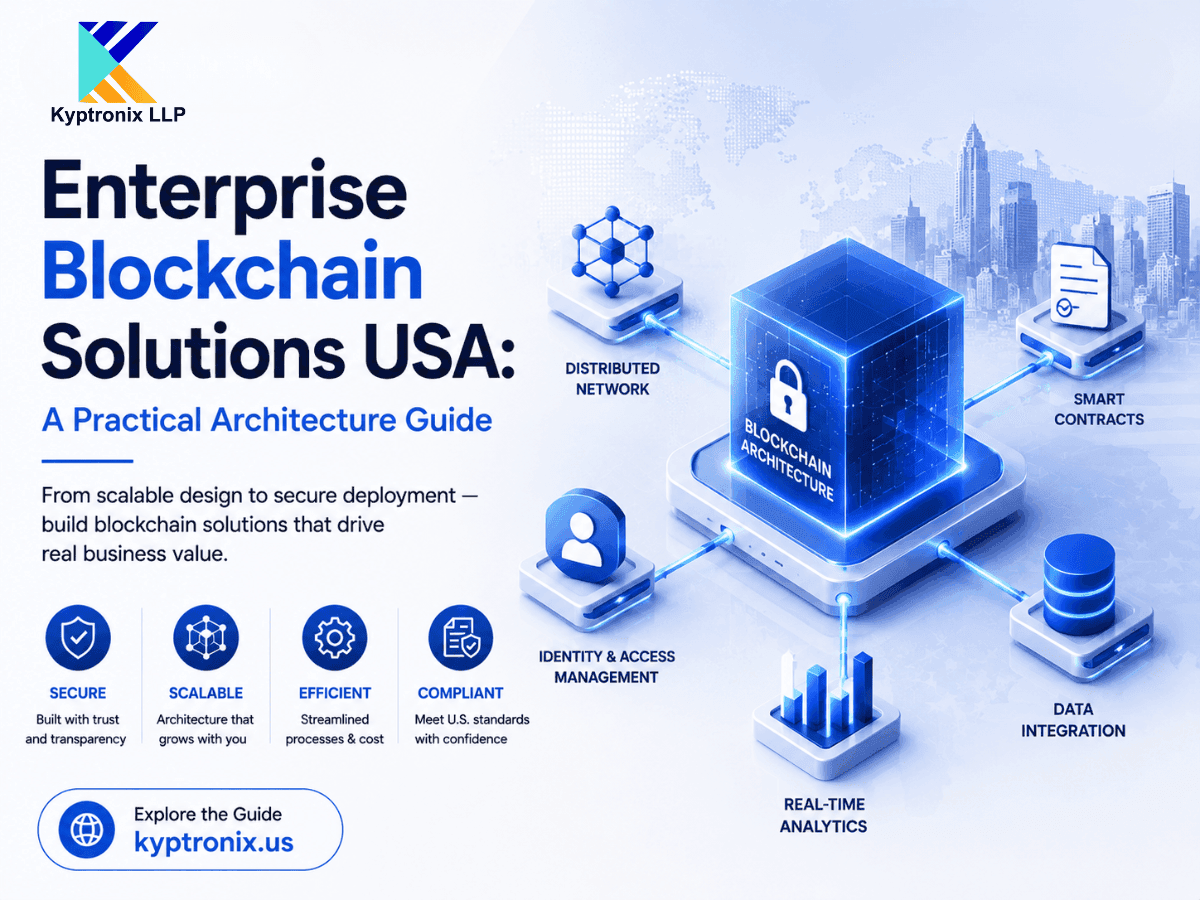
If you have spent any time working with computers in a company, you know the problems that make companies want to use distributed ledger technology. This is because companies do not always trust the information that their partners give them. They also have to spend a lot of time checking everything to make sure it is correct. When they have to prove what they did, it can be very hard to do that. When all the information is in one place, it is easy to keep track of it. When many different companies need to look at and change the same information, it becomes very hard. That is the problem that Enterprise Blockchain Solutions USA is trying to solve. They do not use the kind of blockchain that most people think of, which is open to everyone and uses tokens. Instead, they use a kind of distributed ledger technology that companies can control and keep secure
This guide will explain the ways to set up this technology, where it can really help companies, the problems that can come up, and how to figure out if it is worth spending money on. Enterprise Blockchain Solutions USA is the company that can help with this. Enterprise Blockchain Solutions USA has the solution to these problems.
Public Blockchains vs. Permissioned Enterprise DLT
Public networks like Ethereum or Bitcoin are permissionless by design -anyone can join, validate, and transact. That openness is the point of a public cryptocurrency network. Still, it creates real friction for a business: unpredictable gas fees, transaction data visible to anyone watching the chain, and throughput limits that don't scale to enterprise transaction volumes.
Permissioned blockchain development USA takes a different approach. Every participant is identity-verified before they join the network, and administrators define exactly who can read, write, or validate transactions.
Feature | Public Blockchain | Permissioned Enterprise DLT |
Access Control | Open/permissionless | Restricted, identity-verified |
Transaction Speed | Variable, congestion-prone | Higher throughput, lower latency |
Data Privacy | Pseudonymous, publicly visible | Encrypted, channel-based privacy |
Governance | Decentralised, informal | Consortium or corporate policy |
Compliance Fit | Difficult to align | Designed around frameworks like HIPAA, SOC 2, CCPA |
A few frameworks dominate the enterprise space today:
Hyperledger Fabric: an open-source project under the Linux Foundation, known for its modular design and channel-based privacy. Companies exploring Hyperledger Fabric consulting USA typically land here for supply chain networks and trade finance platforms. If you're weighing whether to build this expertise in-house or bring in specialists, see our guide: Hire Blockchain Developer in the USA: What Enterprises Should Know.
R3 Corda: built specifically for regulated financial institutions, using point-to-point transactions instead of broadcasting state to the whole network.
Enterprise Ethereum (e.g., Hyperledger Besu): combines familiar smart contract tooling with private consensus and enterprise-grade privacy controls.
None of these is universally "best." The right choice depends on your consortium structure, existing tech stack, and regulatory exposure -which is exactly the kind of nuance that gets glossed over in generic blockchain marketing.
Where Enterprise DLT Actually Delivers Value
Blockchain isn't a fit for every workflow; more on that in the ROI section below. But in a few specific use cases, it solves problems that are genuinely hard to solve otherwise.
1. Supply Chain Visibility and Traceability
Fragmented supply chains -especially in pharmaceuticals, manufacturing, and logistics -create high administrative costs through manual reconciliation and disputed custody records. Supply chain blockchain integration lets every party in the chain log custody transfers to a shared, time-stamped, tamper-evident ledger.
For pharmaceutical distributors working under the Drug Supply Chain Security Act (DSCSA), this creates a single audit trail that follows a product from manufacturer to pharmacy shelf, rather than a patchwork of siloed records that have to be reconciled after the fact.
2. Automated B2B Settlements
Manual reconciliation between business partners can stretch a settlement cycle out to weeks. With smart contract implementation for business, agreement logic runs automatically: when an IoT sensor confirms a cargo delivery at a port, a smart contract can trigger escrow release and update ledger balances without a person in the loop. For a closer look at how this plays out in practice, see our related post: How Smart Contract Development Services Are Reducing Costs and Automating B2B Workflows.
3. Decentralized Identity and Access Management
Centralized credential servers are a favorite target for attackers -compromise one server, and you've compromised every account it manages. Decentralized identity enterprise solutions let employees, vendors, and even device endpoints present cryptographically verifiable credentials instead. That reduces how much sensitive identity data has to be exposed just to prove who someone is, and it simplifies onboarding across multi-company partnerships.
In our experience at Kyptronix US, when we tested integration pipelines connecting Hyperledger Fabric nodes to client ERP systems, the consensus layer itself was rarely the bottleneck. The real slowdowns came from data mapping mismatches and REST API adapters that weren't built for the transaction volume -the unglamorous middleware work that doesn't show up in architecture diagrams but determines whether a project ships on time. Teams that plan for that integration layer early tend to avoid expensive refactoring later in the project.
Architectural Edge Cases: Privacy, Compliance, and Integration
This is where enterprise blockchain projects tend to get harder than the sales deck suggests.
The Immutability vs. Privacy Problem
Data written to a blockchain is, by design, permanent. But US privacy laws -the California Consumer Privacy Act (CCPA) and HIPAA among them -give individuals rights to data deletion and restricted processing. Those two facts are in direct tension.
The common architectural pattern is to keep personally identifiable information (PII) off-chain. Store the actual personal data in a conventional database -PostgreSQL or AWS Aurora, for example -and write only a cryptographic hash or zero-knowledge proof to the ledger. When someone requests data deletion, you purge the off-chain record. The on-chain hash remains, but it's no longer linkable to any individual, so you preserve both regulatory compliance and ledger integrity.
This isn't a perfect solution in every jurisdiction or every use case, and it's worth having your legal or compliance team review how it applies to your specific data flows and regulatory obligations before you finalize the architecture.
Legacy System Integration
A distributed ledger that operates in isolation from your existing platforms is close to useless in practice. Legacy ERP blockchain integration -connecting on-chain state changes to systems like SAP, Oracle, or Salesforce -requires secure API middleware and microservices built specifically for that translation layer. This is usually the most underestimated part of the project timeline, and it's worth budgeting real engineering time for it rather than treating it as an afterthought.
For more on connecting modern architecture to existing corporate software, see our related post: "Rethinking Growth: The Modern Approach to IT Outsourcing Services USA".
Regulatory Landscape and Realistic ROI
It's worth being precise here: permissioned enterprise ledgers are not the same regulatory animal as consumer crypto tokens. A properly designed enterprise DLT deployment avoids most token-related securities questions because it isn't issuing or trading a tradable asset -it's running a private data infrastructure.
Several US states have passed statutes recognizing smart contracts and blockchain records as legally binding for commercial purposes. Arizona's Ariz. Rev. Stat. § 44-7061 provides that a signature or record secured through blockchain technology is treated as an electronic signature or record, and that a contract cannot be denied legal effect solely because it contains a smart contract term. Wyoming's 2021 DAO Supplement grants legal entity status to blockchain-based DAOs and recognizes their smart contract governance as binding on members. Delaware, through its Blockchain Initiative and related amendments to the Delaware General Corporation Law, has enabled the issuance, transfer, and redemption of corporate shares via distributed ledger. Tennessee, Nevada, and Illinois have since passed comparable legislation. On the security side, enterprise deployments are generally expected to align with frameworks like SOC 2 Type II, ISO/IEC 27001, and NIST guidance on blockchain and cybersecurity.
For a deeper look at protecting distributed infrastructure, see our post on how Kyptronix approaches security and compliance for blockchain deployments: How Kyptronix Empowers USA Businesses with Secure Blockchain Solutions.
Four Questions to Ask Before You Build
Blockchain technology was created to solve a specific class of problems. Before you invest budget and resources, ask yourself these questions:
Is there a set of data that needs to be simultaneously authored and read by multiple independent entities?
Do any of these entities have divergent interests or a lack of faith in the integrity of the others?
Is there significant reconciliation effort in the current process?
Are regulators demanding an auditable trail that cannot be tampered with?
If you currently operate a process that is contained within the boundaries of a single organization, a conventional cloud database will almost certainly provide faster time to value, more flexibility, and significantly lower operating costs than a distributed ledger. Blockchain provides value when value is created by the participants, not stored by them.
Getting Started
Enterprise blockchain is not a panacea; it is a specific technological solution which has applicability only to a specific class of problems, namely those involving reconciliation between multiple mistrustful parties. When applied correctly, permissioned ledgers can dramatically reduce reconciliation overhead while providing a higher degree of auditability than traditional systems. When applied incorrectly, they add complexity and cost with no tangible benefit. If you're trying to determine whether permissioned blockchain or a larger cloud infrastructure initiative is right for your business, the Kyptronix US team is here to help. Contact us to set up an architectural consultation.
Frequently Asked Questions
1. What are Enterprise Blockchain Solutions USA?
Permissioned distributed ledger platforms designed for US businesses to coordinate multi-party workflows, protect sensitive data, and maintain audit trails that are difficult to alter after the fact.
2. How do permissioned ledgers differ from public cryptocurrencies like Bitcoin?
Permissioned ledgers restrict participation to verified organizations, don't rely on a volatile native token, and are built for predictable throughput and strict data privacy -priorities that differ from a public, open-participation network.
3. Which US industries tend to benefit most?
Healthcare, supply chain and logistics, financial services, insurance, and manufacturing -industries with heavy multi-party compliance requirements and high reconciliation costs.
4. Is enterprise blockchain compliant with laws like CCPA and HIPAA?
It can be, with the right architecture. Keeping personal data off-chain and recording only hashes on-chain is the common pattern for reconciling immutability with data deletion rights -though this should be validated with legal counsel for your specific use case.
5. How does smart contract implementation streamline operations?
Smart contracts execute pre-defined business logic automatically once agreed-upon conditions are met, cutting down on manual paperwork and intermediary delays.
6. How long does an enterprise blockchain deployment typically take?
Timelines vary by scope and integration complexity. A proof-of-concept is often measured in weeks; a production system with legacy integrations is a longer, multi-month engagement. Exact timelines depend heavily on your existing systems and should be scoped project by project.
7. How does legacy ERP integration work with platforms like SAP or Oracle?
Through secure microservices and API gateways that sync relational database records with distributed ledger transactions -this middleware layer is usually the most engineering-intensive part of the project.
8. Are smart contracts legally enforceable under US commercial law?
Generally yes, under federal frameworks like the E-SIGN Act and state-level statutes such as Arizona's Ariz. Rev. Stat. § 44-7061, Wyoming's DAO Supplement, and Delaware's Blockchain Initiative amendments -though enforceability specifics vary by state and by contract, so legal review is recommended for any specific deployment.
9. How can Kyptronix US help with enterprise DLT adoption?
We work through architecture design, smart contract engineering, and API/legacy system integration, drawing on hands-on implementation experience rather than a one-size-fits-all template.