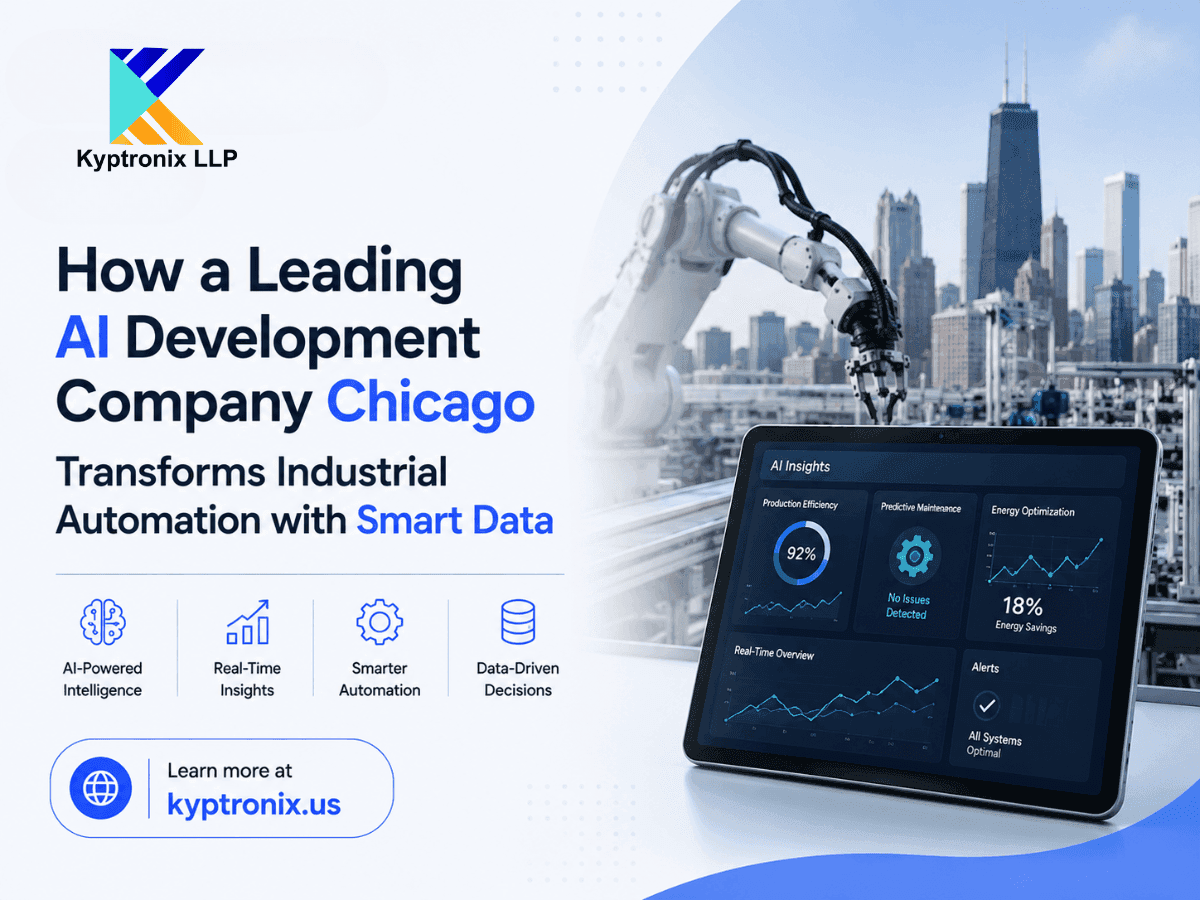
Greater Chicago has been America's industrial heartbeat for longer than most people realize: the manufacturing corridors along the I-88 tech belt, the logistics hubs clustered near O'Hare, the whole Midwest supply chain machine that just keeps running. But the modern factory floor isn't really competing on machinery anymore. It's competing on intelligence.
Every sensor, every conveyor belt, every PLC on the line is spitting out gigabytes of operational data every single hour. And yet most industrial operations are, honestly, drowning in data while starving for actual insight.
That's the gap a specialized AI Development Company Chicago like Kyptronix US exists to close. By pairing smart data engineering with custom machine learning pipelines, manufacturers that lean into this turn raw sensor noise into outcomes they can actually plan around.
Moving Beyond Hype: Why Industrial Automation Needs Smart Data
In industrial settings, "big data" often just means bigger bottlenecks. High-frequency vibration sensors and optical thermal cameras throw off enormous volumes of unorganized records. Push that raw telemetry straight to cloud storage, and you get more latency, higher bandwidth costs, and slower decisions right when speed matters most.
That's why the organizations doing this well prioritize smart data engineering over just hoarding raw data. The idea is to pull clean, contextualized signal out of a noisy operational environment before any of it ever touches an AI model; filter first, model second.
The path generally runs from raw sensor and SCADA data, through that filtering and cleaning layer, into predictive models running at the edge, and out the other side as automated actions: a valve closing, a line slowing down, a maintenance ticket firing off before anyone even walked the floor.
Deloitte's research on AI in manufacturing found something worth sitting with: 84% of industrial organizations report real, measurable value from AI. But only about 20% manage to actually scale that value across an entire facility, let alone multiple plants, mostly because the data foundation underneath it was never solid to begin with. Without structured pipelines, predictive models tend to fall apart the moment operating conditions shift even a little.
Key Applications: Where Smart Data & AI Drive Industrial Value
Paired with the right data architecture, industrial automation solutions unlock real efficiency gains across a production floor.
Predictive maintenance AI is probably the clearest case. Unplanned downtime costs manufacturers billions a year between lost throughput and emergency repair bills. Instead of running on a fixed maintenance calendar, predictive maintenance AI watches vibration, acoustic signatures, and temperature continuously, catching micro-anomalies weeks before something actually breaks, so repairs happen on a planned schedule instead of at 2am.
High-speed optical quality control solves a different problem. Manual inspection leaves room for human error, and it just can't keep pace with a fast assembly line. Computer vision models scan parts at sub-millisecond speeds, catching hairline cracks and surface defects long before final assembly.
Supply chain and inventory optimization rounds it out. One unpredictable material delay can freeze a whole line. Bringing industrial IoT analytics into warehouse operations lets predictive algorithms adjust production schedules on the fly, factoring in supplier lead times, weather, and real inventory levels—not just what the spreadsheet said last week.
What We Actually Learned Building Edge AI Deployment
Industrial automation rarely gets perfect network conditions. High-voltage machinery throws off electromagnetic interference, and underground production floors regularly deal with spotty connectivity—that's just reality, not an edge case.
We ran into this directly while building a custom edge AI deployment for a high-volume Midwestern stamping facility. Cloud processing latency was sitting around 120 milliseconds, too slow to trigger emergency shutoff valves during automated quality checks, which is a genuinely dangerous gap in an industrial setting. So we refactored the model to run directly on local edge hardware, right at the machine interface. That dropped decision latency under 8 milliseconds, and it worked completely offline. No cloud round-trip required.
That experience is a big part of why an experienced AI development partner in Chicago designs for edge-first resilience from the start, rather than bolting it on after something goes wrong.
Overcoming Legacy Integration Challenges
Getting modern AI into an established production facility comes with real constraints, not just theoretical ones.
Protocol fragmentation is a common one: older facilities are still running Modbus, Profibus, or CAN bus, while modern cloud frameworks want MQTT, OPC UA, or RESTful APIs, and bridging those two worlds takes real engineering, not a plugin. Non-stationary noise is another: thermal shifts, dust buildup, mechanical wear — all of it slowly changes what a sensor's baseline reading actually looks like, and an uncalibrated model will quietly drift without anyone noticing until output quality drops. And safety and closed-loop compliance sit above all of it: automated models have to run with strict fail-safes so nothing an AI decides can ever bypass an actual human safety standard.
Moving from a legacy stack—PLCs and SCADA systems talking Modbus or CAN bus, dumping into an isolated on-prem server, manually exported into static spreadsheets—toward a modern smart data AI stack means edge hardware and sensors speaking OPC UA or MQTT, streaming into real smart data engineering, feeding an actual edge AI model in near real time. McKinsey's research on AI in the workplace makes a similar point: successful adoption has a lot less to do with buying off-the-shelf software and a lot more to do with rewiring how the core business actually works day to day.
The Kyptronix Blueprint for Industrial AI Success
Building industrial AI that holds up in production takes a structured process, not a single big launch.
It starts with an architecture and telemetry audit, evaluating existing PLCs, sensor density, and network bandwidth to map out what integration actually requires. From there, we build clean, automated smart data engineering pipelines to filter, aggregate, and normalize incoming telemetry. Model development and offline validation come next, training on historical data and testing performance in simulated conditions well before anything touches live hardware. Then a phased edge deployment, rolling lightweight models onto edge hardware and testing response times alongside the humans who are actually running the floor. And finally, continuous monitoring and retraining: closed-loop checks that catch model drift early, so performance holds steady across every shift, not just the one where it launched.
With real machine learning integration discipline, companies see measurable operational gains without gambling on unplanned downtime to get there.
Conclusion
The future of industrial manufacturing belongs to the organizations that actually convert operational telemetry into automated action, not just the ones collecting the most data. Partnering with a dedicated AI development team lets you turn raw data streams into intelligence that's scalable and, more importantly, reliable.
Whether the goal is cutting unplanned downtime with predictive maintenance AI or building real-time computer vision systems, Kyptronix US builds software for environments that don't forgive sloppy engineering.
Ready to modernize your operations? Contact Kyptronix US today to schedule a technical consultation and talk through what custom industrial AI could look like for your business.
Frequently Asked Questions
What makes a Chicago-based AI development company ideal for industrial automation?
Chicago's got a dense network of manufacturing, logistics, and engineering operations already in place. Working with a local partner like Kyptronix US means real proximity, on-site hardware testing support, and a genuine, ground-level understanding of Midwest supply chain realities; not a theory of them.
How does smart data differ from big data in industrial settings?
Big data is about storing huge volumes of raw information. Smart data engineering filters, cleans, and contextualizes that information right at the point of creation, turning raw telemetry into signal that's actually ready for real-time model analysis.
Can AI models integrate with legacy PLCs and SCADA networks?
Yes, using custom edge gateways and protocol converters like OPC UA wrappers, modern machine learning algorithms can talk to legacy PLCs securely without ripping out existing control systems.
How long does a typical industrial AI project take to deploy?
Initial proof-of-concept models generally take 6 to 10 weeks. Enterprise-wide rollouts run more like 3 to 6 months, depending on facility size, hardware readiness, and how mature the data pipeline already is.
What are the bandwidth requirements for edge AI deployment?
Since processing happens locally on the edge device, external bandwidth needs stay minimal. Really, only summarized health metrics and periodic retraining logs sync back to the cloud.
How does predictive maintenance reduce operating costs?
Predictive maintenance AI catches subtle component wear before it becomes a failure. That extends machine lifespan, cuts down on emergency part air-freight costs, and eliminates the unscheduled downtime that tends to be the most expensive kind.
Is custom enterprise AI development more cost-effective than off-the-shelf software?
Often, yes. Off-the-shelf AI software tends to struggle with proprietary hardware setups and non-standard protocols. Custom enterprise AI development tailors the model to your actual hardware, which usually means better performance and lower integration costs over the long run.
How do you prevent machine learning models from drifting over time?
We run automated drift detection that monitors incoming telemetry against baseline distributions. When sensor calibration shifts, the system either alerts engineers directly or kicks off an automated retraining pipeline on its own.
What security measures protect proprietary industrial data?
Hardware-level encryption (TLS 1.3), role-based access control, isolated local network segments, and on-premises edge processing all work together to keep industrial IP where it belongs.
How does Kyptronix US start a new industrial AI engagement?
With a strategic technical audit assessing your data sources, control systems, and operational goals before recommending anything. Contact our team to schedule an initial consultation.