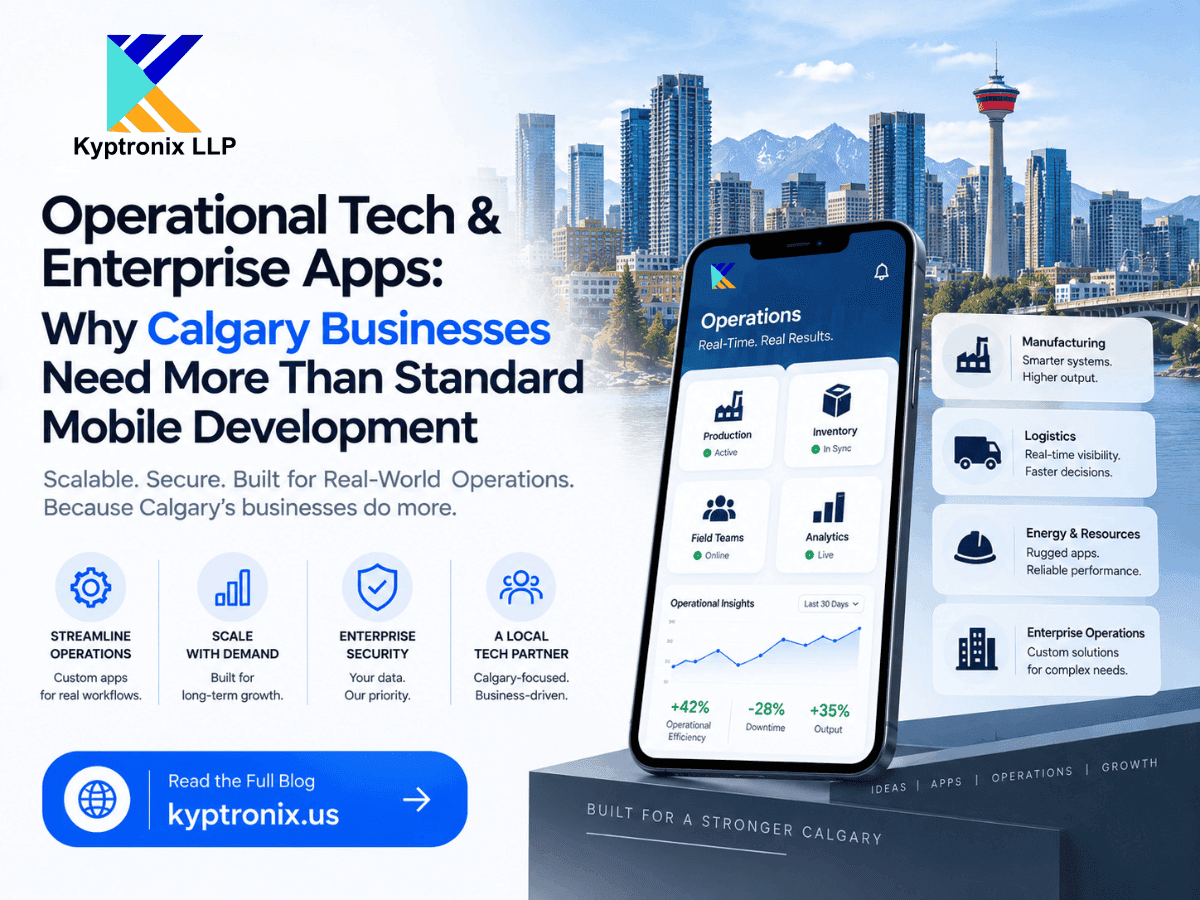
Calgary's commercial landscape doesn't sit still. Between the energy corridors, the logistics hubs, and a downtown tech scene that keeps growing, Alberta companies stopped treating mobile apps as a marketing afterthought a while ago. Field technicians, asset managers, enterprise directors , they're running actual operations through these interfaces every single day.
That changes the requirements. When your workforce is out in harsh environments, remote job sites, or navigating a supply chain with a dozen moving parts, an off-the-shelf app simply won't hold up. What you need is an engineering team that's actually dealt with real-world operational constraints before. If you're looking for a Mobile App Dev Company in Calgary, the search has to go past basic consumer app design , durability, offline resilience, and deep system integration are the things that actually matter here.
Why Standard Mobile Apps Fall Apart in the Field
We've engineered field solutions for heavy industry long enough to know: consumer-grade app frameworks crumble fast once they hit rugged operational settings.
One project stands out , offline data sync for an asset tracking tool in Northern Alberta. The failure point was almost always the same: satellite connectivity dropping out. In job sites with intermittent, sometimes zero-bar signal, typical apps freeze up, lose cached form entries, or corrupt the database queue the moment connection comes back.
That's the wrong way around. Reliable Calgary enterprise apps need to be built for the worst connectivity scenario first, not as an edge case handled later. A field worker recording a safety compliance log or a valve pressure reading can't afford to lose that data because the app assumed a stable connection.
[Field Worker UI, glove- and glare-optimized] → [Local SQLite Queue, encrypted offline buffer] → [Conflict-Free Sync Engine] → [Secure REST/WebSocket API Gateway] → [Legacy ERP / SCADA]
The Edge Cases Nobody Thinks About Until They're a Problem
Operational tech app development runs into constraints that consumer apps simply never encounter:
Technicians working in heavy gloves need touch targets sized well above the norm , 48x48 dp minimum, plus high-contrast dark modes so a tablet screen doesn't disappear in snow glare. Hardware triggering is its own challenge too: intrinsic safety devices, RFID readers, thermal cameras over Bluetooth LE all need native drivers, not a web view pretending to talk to hardware it can't actually reach.
And then there's the conflict problem. Picture three field engineers editing the same pipeline schematic offline at the same time. When they all reconnect, whose edit wins? That's where Operational Transformation or CRDTs come in, without one of those, you just get silent data loss, which is worse than no offline mode at all.
Bridging Modern Apps and Decades-Old Backends
Building iOS and Android apps that Calgary enterprises can actually trust means connecting two worlds that were never designed to talk to each other: fast, modern mobile frameworks and legacy backend systems that predate mobile entirely.
A lot of industrial operators are still running SAP, Oracle, or custom SCADA setups , none of which were built with REST APIs or mobile sockets in mind. Getting real-time telemetry out of them and into something like a lightweight JSON stream, without hammering enterprise firewalls or exposing critical infrastructure to the open internet, takes a proper middleware layer. There's no shortcut around it.
[Field Sensor / SCADA] → [On-Prem Gateway] → [Mobile API Layer] → [Calgary Enterprise Mobile App]
This integration gap is a known bottleneck industry-wide; poor connections between legacy operational systems and modern interfaces are a major driver of the delays that plague enterprise mobile rollouts.
Native or Cross-Platform? It Depends What You're Building
Every technology leader ends up facing this decision at some point: build separate native apps, or go cross-platform with something like Flutter or React Native?
Native (Swift/Kotlin) | Cross-Platform (Flutter/React Native) | |
Hardware access (Bluetooth LE, RFID) | Direct, high performance | Needs custom native bridges |
Development cost | Separate codebases, higher cost | Single codebase, notably faster |
UI consistency | Follows platform conventions | Pixel-perfect across devices |
Best fit | Hardware-heavy OT, AR/VR field tools | Dashboards, workflow management |
For most enterprise tracking and field reporting work, cross-platform hits the right balance of speed and long-term maintainability. But the moment you're dealing with direct sensor telemetry or specialized hardware manipulation, native is still the safer bet , no framework has fully closed that gap yet.
What Actually Matters When Choosing a Calgary Partner
Data governance. Any Canadian app touching operational or personnel data has to hold up against PIPEDA and relevant provincial health-and-safety regulations. That means encryption at rest and in transit, and hosting through Canadian infrastructure, AWS Canada Central, Azure Canada East, that tier.
Security, taken seriously. Enterprise apps are a real target, not a theoretical one. Look for a workflow that includes automated SAST scanning, regular penetration testing, and role-based access control wired directly into your identity provider, Azure AD, Okta, whatever you're already running.
A field strategy that's actually been tested. Ask how a potential partner handles failure states in practice. Network latency drop-offs, sudden power loss mid-write on a local database , these aren't hypotheticals in the field; they're Tuesday. A partner who hasn't tested for them hasn't really built for the field.
Ready to Move Past Paper Forms and Legacy Terminals?
Outdated processes and unreliable field software cost more than they seem to , in lost time, lost data, lost visibility. A properly built mobile system gives your team real-time confidence in what's happening on the ground, wherever that ground is.
If you're evaluating a Mobile App Dev Company in Calgary, schedule a technical discovery call with Kyptronix to walk through architecture options, field integration strategy, and a realistic project roadmap.
Frequently Asked Questions
1. How much does enterprise mobile app development cost in Calgary?
Enterprise mobile app development in Calgary generally ranges from $35,000 to over $150,000 depending on scope. Simple internal utility apps occupy the lower end, while complex Calgary enterprise mobile applications with offline sync, legacy ERP integrations, and custom hardware support fall into higher tiers.
2. How long does it take to develop an operational tech mobile app?
A typical enterprise mobile application takes between 3 and 6 months from discovery to initial production launch. Phased rollouts allow teams to deploy core features to field testers early while refining advanced modules in parallel.
3. Should we build native apps or choose cross-platform mobile app development?
Choose cross-platform mobile app development if you need fast deployment across both iOS and Android with shared business logic. Choose native development if your app requires specialized low-level hardware communication, complex Bluetooth sensor integrations, or maximum GPU rendering performance.
4. How do mobile apps handle offline functionality in remote Alberta locations?
Engineers implement an offline-first architecture using local encrypted database, such as SQLite or Realm. The application writes all user actions to a local queue and uses background sync services to upload changes to central servers as soon as network connectivity is restored.
5. Can mobile apps connect directly to legacy SCADA or ERP systems?
Yes. Developers build secure API middleware layers or microservices that act as translation bridges between modern mobile endpoints and legacy protocols, such as OPC UA, Modbus, or SOAP interfaces.