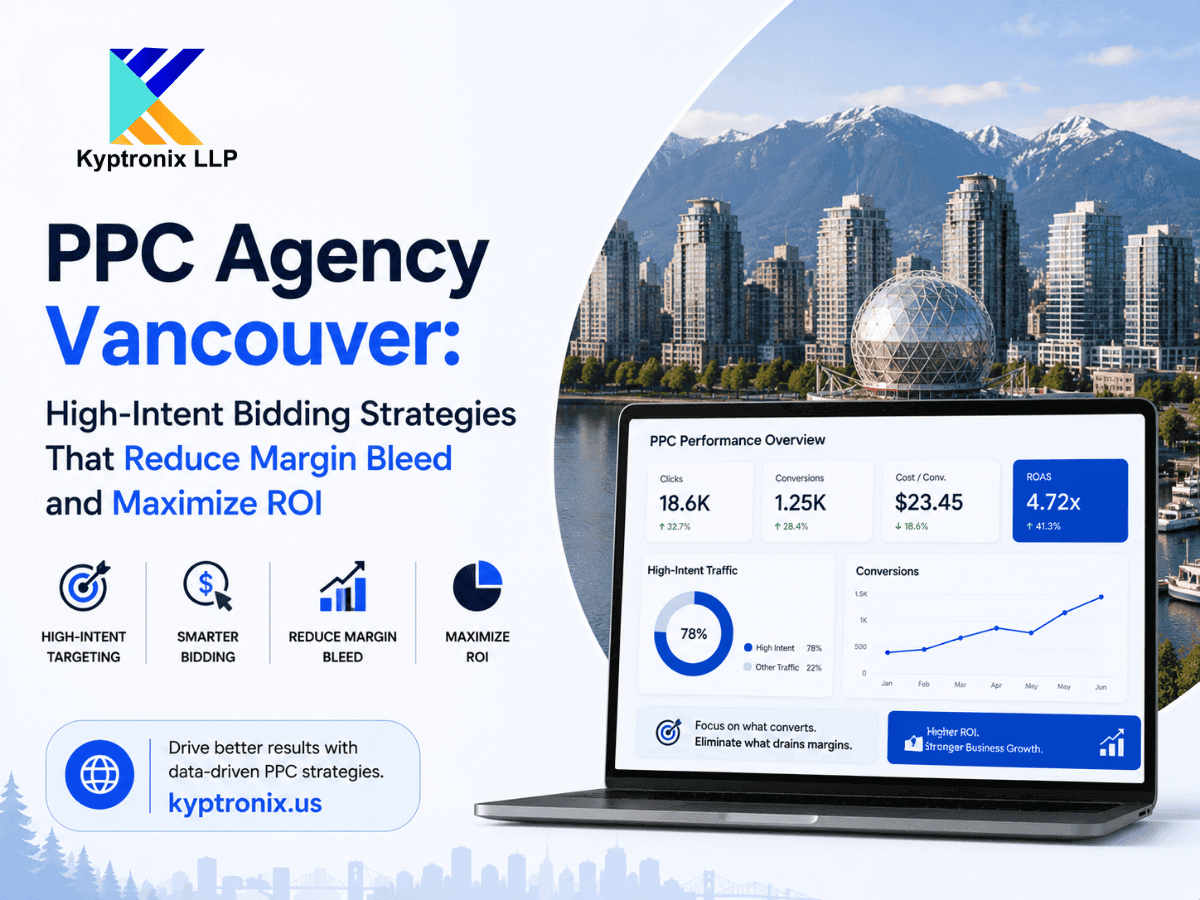
Most businesses jump into Google Ads expecting growth they can measure. A few months in, though, something feels off. The campaign looks fine on paper. Traffic's up. But profitability keeps slipping through the cracks anyway, and nobody's quite sure why.
Usually it comes down to the same handful of things: inefficient bidding, clicks that never had a real shot at converting, targeting cast too wide to do much good. Traffic matters, sure, nobody's arguing that. But the right traffic is what actually protects your budget. The wrong kind just burns it quietly.
That's the gap a good PPC Agency Vancouver fills. Instead of chasing more clicks, the smarter move is high-intent bidding, putting money behind the users who are actually likely to buy and pulling it away from searches that were never going anywhere in the first place. For businesses in Vancouver, and honestly across Canada, this usually means tighter campaigns, less wasted spend, and profitability that holds up over time instead of quietly eroding.
Why High-Intent Bidding Matters More Than Ever
Not every click carries the same weight, not even close. Someone typing "best accounting software for small business" is a lot closer to buying than someone typing "what is accounting software?" Same general topic. Completely different level of intent.
A PPC Agency Vancouver that actually knows what it's doing picks up on that difference fast. Budget shifts toward keywords that signal someone's ready to purchase, not just curious and browsing. That's how wasted ad spend, often called margin bleed, gets cut down, while the quality of leads reaching your sales team goes up.
What Margin Bleed Actually Looks Like
Margin bleed is what happens when ad spend slowly chips away at profitability without much to show for it. There are a few usual suspects here. Keyword targeting that's too broad. Thin negative keyword lists. Weak audience segmentation. Landing pages that don't convert. Aggressive bids sitting on low-value searches. Traffic that was never qualified to begin with.
A lot of advertisers see their ad costs creeping up and just assume it's more competition. Sometimes it is. More often, though, it's inefficient traffic quietly eating the budget in the background. A solid PPC Agency Vancouver audits accounts regularly, catching this stuff before it turns expensive.
How High-Intent Bidding Actually Works
The idea itself is pretty simple. Put money behind users showing real buying signals, not just anyone who happens to click through.
Commercial search queries. Instead of bidding on something broad like "CRM," go after "best CRM software for manufacturing companies." Much closer to an actual purchase decision.
Geographic intent. Location-based searches usually mean someone's closer to acting. "Roof repair Vancouver." "Dentist downtown Vancouver." That kind of thing.
Brand comparison searches. Someone typing "Shopify vs WooCommerce" or "best cybersecurity company Vancouver" is already comparing options, further down the funnel than someone just browsing around.
Returning visitors. Remarketing audiences tend to convert better than first-timers, and Google's audience signals can help prioritize them properly, if you're actually using them.
Cutting Margin Bleed Takes More Than Just Lowering CPC
There's a common assumption floating around: drop your cost-per-click, profitability follows. Not always true, not even close sometimes. A pricier keyword can convert far better than a cheap one that barely does anything at all.
A capable PPC Agency Vancouver looks past click costs entirely. Cost per acquisition, conversion value, ROAS, customer lifetime value where it's available, overall lead quality, these are what actually matter.
What We've Learned Running High-Intent Campaigns
Campaigns tend to improve the most once decisions get driven by intent rather than raw traffic numbers. In one comparison for a B2B client, we tested two approaches side by side, one built around broad, high-volume keywords, the other focused on commercial-intent terms backed by tighter negative keywords and better audience segmentation.
The high-intent version pulled in fewer clicks overall. But the inquiries it generated were noticeably more qualified, and budgeting got a lot simpler once less spend was going toward purely informational searches. Results shift depending on industry, competition, seasonality, and the site itself; that's just how it goes. But the pattern held up: better-qualified traffic usually beats a bigger pile of traffic.
Putting Together a High-Intent Campaign
Keyword selection. Every keyword needs a clear tie to a business goal. For lead generation, commercial keywords generally outperform informational ones, no surprise there.
Negative keywords. These keep your ads from showing up on searches that were never going to convert; think "jobs," "tutorial," "internship," "definition," "free." Reviewing search terms regularly helps you keep expanding this list over time.
Audience segmentation. Not every visitor should get the same bid, not even close. Worth prioritizing separately: previous site visitors, cart abandoners, existing customers, specific regions, even device type sometimes.
Smart bid adjustments. Automated bidding can work well, but it needs solid conversion tracking and enough historical data behind it to actually perform well. Worth keeping an eye on rather than assuming it'll always beat manual optimization, because it won't always.
Landing Pages Affect Margin Too
Even a perfectly targeted click can fall flat if the landing page gets in the way. The pages that hold up tend to share a few things: a clear value proposition, messaging that actually matches the ad, fast load times, mobile responsiveness, visible trust signals, a straightforward call-to-action. Fixing the post-click experience often does as much for conversions as the bidding strategy itself does, maybe more.
What to Look for in a PPC Agency Vancouver
Transparent reporting. You should be able to see cost per conversion, conversion trends, search term insights, budget allocation, and clear optimization recommendations, not just a vague performance summary that says everything's going great.
Ongoing optimization. PPC isn't a set-it-and-forget-it service, whatever some agencies might imply. Expect continuous ad copy testing, bid adjustments, audience refinement, landing page tweaks, negative keyword expansion.
Metrics tied to your business. Reporting should track back to qualified leads, sales, or revenue. Not just clicks and impressions dressed up to look impressive.
Steer clear of anyone promising guaranteed rankings, instant ROI, or fixed conversion rates. Too much of PPC performance depends on factors outside any one agency's control for those kinds of guarantees to mean much of anything.
Ready to build smarter PPC campaigns?
At Kyptronix US, we help businesses build data-driven Google Ads strategies centered on high-intent audiences, smart budget allocation, and constant optimization. Whether you're launching something new or fixing up an existing campaign, our team can help shape a PPC strategy built around your actual growth goals. Reach out to Kyptronix US to start building campaigns that prioritize quality over sheer volume.
Start your PPC campaign today. Click here
Conclusion
Good PPC management isn't just about racking up clicks. It's about reaching the right people at the right moment while keeping your budget intact. Lean into high-intent bidding, sharpen your keyword strategy, and keep optimizing, and margin bleed becomes a lot easier to control.
If you're looking for a PPC Agency Vancouver, find a partner that brings real technical know-how, reports transparently, and actually ties strategy back to your goals. Long-term PPC success comes from continuous refinement — not a single campaign launch and walking away.
Frequently Asked Questions
1. Why hire a PPC Agency Vancouver?
A specialized agency handles keyword targeting, bidding strategy, conversion tracking, and ongoing optimization, all shaped around your actual business goals.
2. What exactly is high-intent bidding?
It's about putting ad spend behind search queries and audiences showing real purchase intent, rather than just chasing traffic volume.
3. What does "margin bleed" mean in PPC?
It's the slow erosion of profitability from inefficient spend, irrelevant clicks, or campaigns that just aren't optimized well.
4. Is a lower CPC always a good thing?
Not necessarily. A cheaper click that never converts is worth less than a pricier one that does.
5. How often should PPC campaigns get optimized?
Regularly; how often depends on budget, traffic, seasonality, and what you're trying to achieve.
6. Can automated bidding replace manual work entirely?
It can work well, but only with solid conversion tracking and enough data behind it. Human oversight still helps.
7. How much do landing pages really matter?
A lot. Keywords, ads, and landing pages all need to line up for paid traffic to actually convert.
8. Which PPC metrics matter most?
Cost per acquisition, ROAS, conversion rate, conversion value, and lead quality.
9. How long until PPC performance actually improves?
Some changes show impact fast. Bigger gains usually take weeks or months of continuous testing.
10. Can Canadian businesses compete against bigger advertisers?
Yes, a well-structured campaign with smart targeting and bidding can compete even in crowded industries.