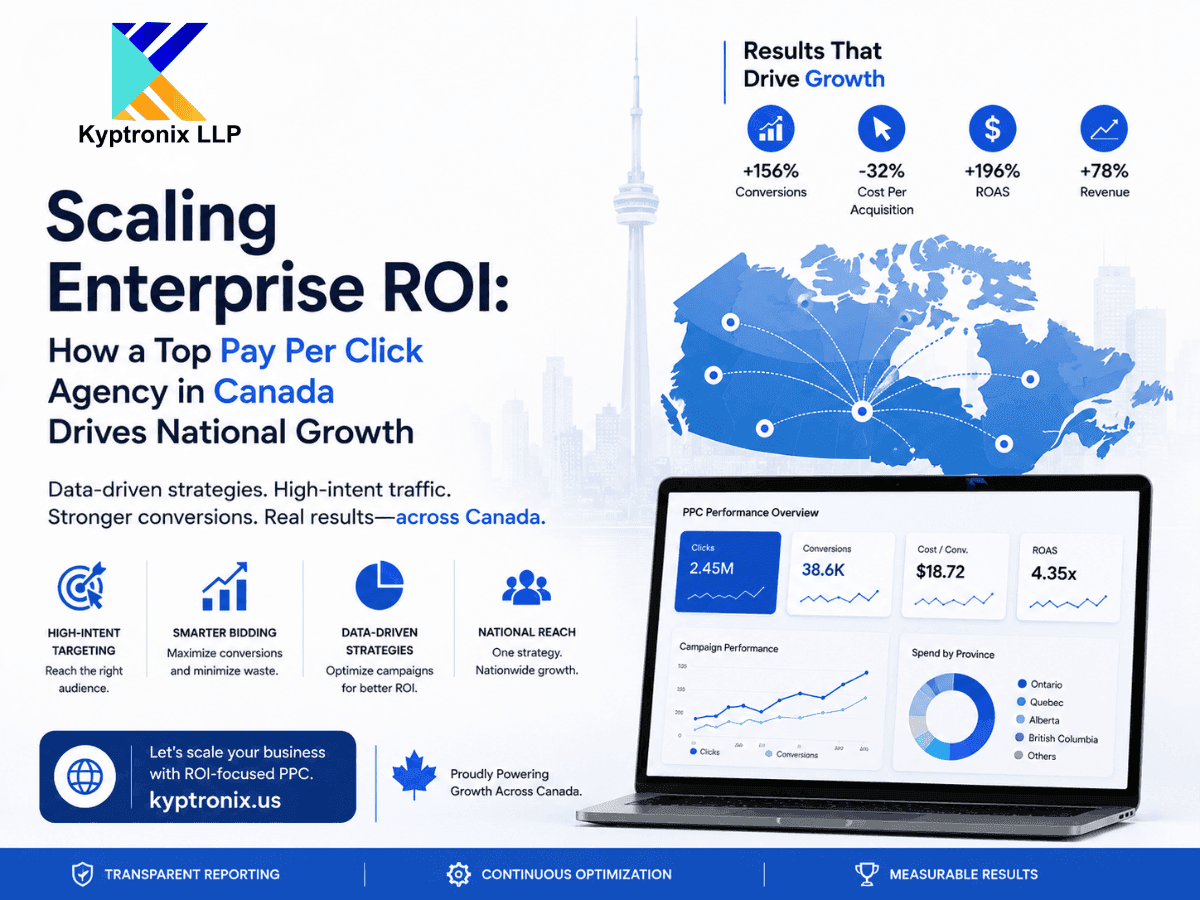
Something like $18.9 billion gets spent on digital ads in Canada every year, and paid search takes over 46% of that on its own. If you're running an enterprise brand trying to actually build market share nationally, that number isn't background noise — it's basically the whole growth engine. And yet most brands still make the same mistake when they try to scale: they think of Canada as one market. It isn't. It's six time zones, two official languages, and a pile of provincial privacy laws that don't always agree with each other, all operating under one flag.
That mistake gets expensive once your monthly spend crosses into five or six figures. At that point you actually need a specialized Pay Per Click Agency in Canada — not a shop running one national campaign with a few location tags thrown on top, but real enterprise PPC management built around how the country's geography actually works.
Coast-to-Coast Is Harder Than the Map Suggests
Pacific time in Vancouver to Newfoundland time in St. John's — that's the spread you're working with. Run a single, unsegmented ad schedule across all of it and here's what happens: your ads are burning impressions in Halifax at 2am while your Calgary sales team is still asleep. Not ideal. A serious national PPC strategy splits the budget into regional tiers and uses day-parting so ads actually run when each market is awake and buying, not just whenever the algorithm feels like spending.
Quebec is its own conversation entirely. Under Bill 96, advertising to Quebec consumers means genuinely equivalent French messaging, not English copy run through a translation tool and called done. Get it wrong and you're not just losing conversions — you're picking up compliance risk on top of it. Then Law 25 layers consent and data-handling rules on top of that, which, frankly, is reason enough on its own for why a copy-paste national playbook falls apart the second it touches Quebec.
And then there's currency, which almost nobody accounts for until it's already cost them money. Google Ads and Meta bill in USD by default. A budget planned in CAD without anyone watching the exchange rate can drift 3% to 7% over a quarter — quietly, with no single moment where it looks like a problem until the invoice does.
What Enterprise-Grade PPC Actually Looks Like
Regional account structure matters more than most teams give it credit for. Instead of dumping everything into one "Canada-wide" campaign that eats its own budget alive, stronger setups split by tier — Tier 1 metro hubs like Toronto, Vancouver, and Montreal where CPCs run brutal; Tier 2 growth markets like Calgary, Edmonton, and Winnipeg where conversion cycles move faster; Tier 3 regional coverage where volume's lower but you can target with a lot more precision. Cross-province ad scaling, done properly, just means Toronto's expensive mornings stop quietly draining the account before Western Canada's day has even started.
Bilingual campaigns are the other piece people underinvest in, usually because it's easy to assume translation software is close enough. It isn't. French speakers make up roughly 22% of the population, and Quality Score notices immediately when ad copy doesn't actually read like something a native speaker wrote. Real bilingual PPC campaigns use native French copywriters for headlines, extensions, landing pages — the whole path, not just the ad itself. Relevance is what the platform's rewarding, and machine translation rarely earns it.
Omnichannel visibility rounds this out. Enterprise buyers don't convert on click one — that's just not how longer B2B decision cycles work. Tying Google Search together with LinkedIn, Microsoft Advertising, and YouTube retargeting keeps the brand in front of a buyer through however many touches it actually takes them to say yes.
A Real Example, Because Theory Only Gets You So Far
A national logistics client came to us spending $45,000 a month across the country. The audit found exactly the kind of problem described above, 62% of that budget sitting in Ontario alone, leaving Western Canada underfunded right when it should've been peaking. Their Quebec ads, on top of that, were straight machine translations pointing to a landing page that was entirely in English. Conversion there was sitting at 0.8%, which, honestly, tracks.
We split the account into four regional tiers, added automated bid adjustments tied to local business hours, and built landing pages in native French that actually held up under Bill 96. Ninety days out: CPA down 31%, qualified inbound leads from Quebec up 44%.
Picking the Right Partner
Worth looking past the pitch deck here. A standard agency runs one national campaign, uses automated translation for anything in French, tracks little beyond basic form submissions, and calls a generic privacy policy "compliance." An agency actually operating at enterprise scale looks different, segmented provincial architecture, native French copywriters and dedicated landing pages, offline conversion imports wired into your CRM, and consent frameworks genuinely built for Law 25 and PIPEDA, not bolted on after the fact.
Ready to Scale Nationally?
Kyptronix US builds paid search systems around exactly this kind of complexity, the time zones, the language requirements, the currency drift, all of it. If your spend has outgrown whatever setup got you here, request a free enterprise PPC audit and find out where the budget's actually leaking before a competitor beats you to it.
Frequently Asked Questions (FAQ)
1. How much ad spend is required for national enterprise PPC in Canada?
National campaigns in Canada typically require a minimum ad budget of $5,000 to $15,000 per month for targeted B2B verticals, while high-volume enterprise consumer brands often invest $30,000 to $100,000+ monthly to maintain dominant visibility across all provinces.
2. How do you handle bilingual advertising for Quebec compliance under Bill 96?
Bill 96 requires commercial messaging targeting Quebec consumers to be accessible in French with equal or superior prominent formatting. We deploy dedicated native-French search campaigns, ad extensions, and localized landing pages created by native French content strategists.
3. What privacy laws impact enterprise PPC campaigns in Canada?
Enterprise campaigns must comply with PIPEDA at the federal level and Law 25 in Quebec. These regulations mandate explicit user consent for tracking pixels, clear privacy disclosures, and secure handling of first-party consumer data.
4. Why is running a single national campaign ineffective in Canada?
Canada's vast geographical footprint creates significant variations in CPCs, customer behavior, and time zones. A single campaign allows high-cost markets like Toronto to consume ad budgets early in the day, starving Western and Atlantic markets of ad visibility.
5. How do time zones affect bidding strategies in coast-to-coast campaigns?
With six time zones spanning 4.5 hours from PST to NST, ad schedules must be tailored locally. Automated scripts adjust bid modifiers based on operating hours in each regional market to ensure ads run when sales teams are available to respond.