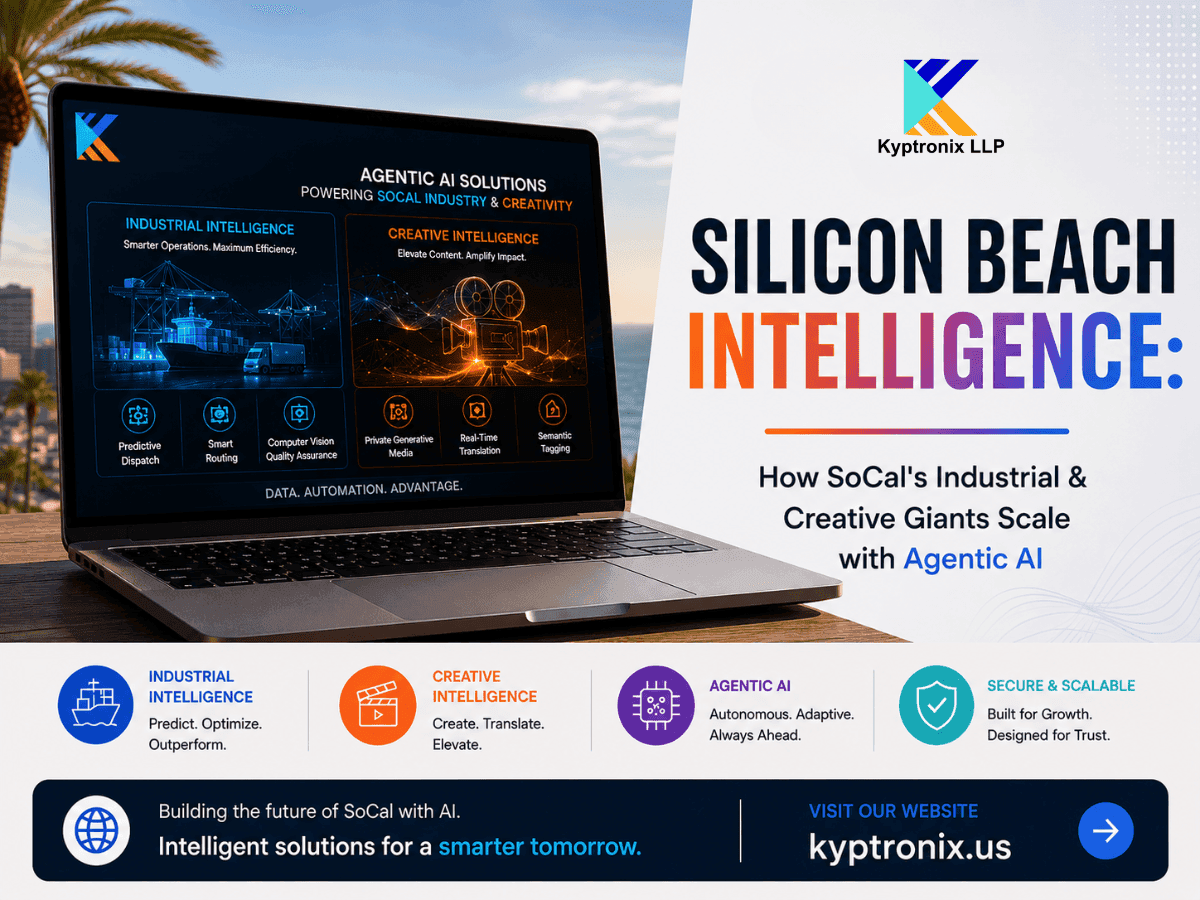
Something extraordinary is happening beneath the palm trees of Southern California (SoCal). For decades, Los Angeles has been globally recognized as the undisputed capital of storytelling and creative expression. From the historic movie lots of Burbank and Culver City to the vibrant neighborhoods of the Westside, LA’s cultural footprint is massive. Today, however, a new narrative is being written. The physical grit of the Port of Los Angeles, the busiest container port in North America, is merging with the intellectual caliber of "Silicon Beach" to turn Southern California into one of the most explosive cognitive technology hubs in the world.
We have moved decisively past the initial wave of artificial intelligence experimentation. Modern enterprise leaders in Los Angeles are no longer satisfied with generic, off-the-shelf chatbots. They are asking highly technical, localized questions: How do we deploy autonomous logistics coordinators at our warehouses near the ports? How do we build secure, private media translation engines in Culver City? How do we ensure our data pipelines remain fully compliant with the California Consumer Privacy Act (CCPA)?
To navigate this complex technological shift, businesses must move away from generic templates toward custom-engineered codebases. Partnering with a premier AI Software Dev Company Los Angeles is the definitive first step toward transitioning your operational infrastructure into highly automated, margin-protecting digital assets.
SoCal's Dual-Engine Cognitive Economy:
├── Creative Sector (Culver City / Burbank) ──> Private Generative Media, Translation, Semantic Tagging
│
└── Logistical Corridor (Port of LA / Long Beach) ──> Predictive Dispatch, Smart Routing, Computer Vision QA
The Port & The Studio: Unique Regional Demands in Southern California
Unlike geographically concentrated tech hubs that focus on a single industry, the Los Angeles metropolitan area requires a unique, dual-engine approach to technological innovation.
On the creative side, major entertainment networks and streaming giants are processing petabytes of raw video and audio telemetry daily. Managing this content at scale requires highly specialized media pipelines capable of running real-time translation, semantic content tagging, and automated digital asset management without risking intellectual property leaks.
Conversely, the massive logistics corridors stretching from the Port of Los Angeles to the Inland Empire are dealing with an entirely different operational challenge. These businesses are locked in a daily battle against supply chain friction, yard congestion, and complex cargo routing.
To solve these physical bottlenecks, Silicon Beach AI Developers are deploying predictive analytics models that optimize cargo dispatch workflows. By analyzing real-time port telemetry, historical transit records, and weather feeds, these models predict exactly when a shipping container will clear customs, allowing dispatch teams to schedule pickup trucks with absolute temporal precision.
To visualize the mathematical efficiency of these predictive dispatch systems, we can model the estimated queue clearance latency (Lq) of a container terminal. Let W represent the multidimensional matrix of neural network weights, X represent the vector of real-time operational inputs, such as yard crane utilization, truck arrival rates, and terminal traffic density, and Φ represent the localized terminal structural penalty. The optimization objective function is modeled as:
Lq (X; W) = WT X + Φ(X) |
To minimize this queue latency, performance engineers continuously adjust the system's weight parameters by minimizing the total regularized loss (E(W)) across all historical transit events:
E(W) = 1 ➗ M ⅀Mm=1 (Lq (Xm; W) - Ym)2 + 𝜸R(W) |
Where:
Ym represents the actual, real-world recorded clearance delay for shipment $m$.
R(W) represents the regularization penalty used to prevent the predictive model from overfitting on local cargo anomalies.
𝜸 is the scaling factor balancing accuracy with operational generalization.
By deploying these advanced mathematical frameworks, a specialized AI Software Dev Company Los Angeles can help logistics enterprises eliminate truck turn-time delays, optimize warehouse labor allocations, and protect their operational margins.
Local Case Study: Re-Engineering Smart Dispatch at the Port of Los Angeles
To understand the real-world return on investment of custom cognitive computing, let us analyze a localized case study involving a major supply chain logistics provider operating out of San Pedro Bay.
The Challenge
The logistics provider was experiencing severe operational bottlenecks. Due to highly unpredictable terminal congestion at the Port of Los Angeles, their container drayage dispatchers had to rely on manual, retrospective estimates to schedule truck arrivals. This lack of visibility resulted in excessive "wait-time" fees, underutilized truck fleets, and high driver turnover, draining their profit margins.
The Custom Solution
To eliminate this operational friction, engineers bypassed generic SaaS platforms to construct a custom, private predictive dispatch engine. They integrated real-time API feeds from port scheduling networks, regional highway traffic sensors, and local weather telemetry into a centralized, secure data pipeline.
Next, they trained a specialized machine learning model using historical terminal container dwell times. By utilizing a secure, private cloud environment, the company ensured that its proprietary routing schedules and client dispatch records remained completely shielded from public networks.
Secure Supply Chain AI Pipeline:
[Real-Time Port APIs] ──> [Edge Anomaly Filters] ──> [Custom ML Predictive Engine] → ↓
[Optimized Truck Dispatch] ← ↓
The Results
The deployment of this custom predictive engine yielded immediate, compounding financial returns:
Truck Idle Times Reduced by 42%: Dispatchers scheduled container pickups with high temporal accuracy, slashing expensive terminal wait times.
Daily Fleet Capacity Increased by 28%: Without adding new trucks, the client completed more container transfers per day by maximizing the efficiency of their existing fleet.
Operational Costs Reduced by 18%: The reduction in idle-time fees and optimized routing directly boosted their net profit margins.
This real-world success demonstrates that custom-tailored software models, built specifically for Southern California's unique logistics ecosystem, consistently outperform general, off-the-shelf software packages.
The Technical Infrastructure: Scaling with Enterprise AI Solutions LA
Building a high-performance system that can scale seamlessly across a regulated corporate environment is an intricate, multi-tiered engineering challenge. To transition from basic prototypes to production-grade deployments, your technical stack must prioritize security, data compliance, and ultra-low latency.
Secure Enterprise Infrastructure Stack:
├── Edge Devices / IoT Nodes ──> Real-Time Sensor Processing & Anomaly Filtering
├── Private Cloud Gateway ──────> Secure Tokenization & PII Anonymization
└── High-Performance RAG ──────> Dynamic Semantic Document Search & Real-Time Context Insertion
Any enterprise-grade product engineered for the US market must implement a robust, multi-layered data governance pipeline:
1. Compliance-First Data Anonymization
Under the strict rules of the California Consumer Privacy Act (CCPA), businesses must ensure that any personally identifiable information (PII) is automatically scrubbed or tokenized before it is processed by an AI model. Custom integrations construct automated preprocessing filters that identify and secure sensitive customer profiles, billing details, or geographical records before data is sent to the model's logical thread.
2. High-Performance Retrieval-Augmented Generation (RAG)
To prevent mathematical hallucinations and ensure consistent, audit-ready outputs, modern architectures connect language models directly to secure corporate databases. By converting internal training manuals, operational specifications, and transaction logs into high-dimensional vector embeddings, the model can query real-time, verified files to answer complex employee or customer queries with near-zero error.
By working with an agency specializing in Enterprise AI Solutions LA, businesses can bypass standard third-party APIs in favor of private, containerized model deployments. This advanced setup ensures that your proprietary business logic and client records remain fully protected within your secure private cloud.
Optimizing for the Next Generation of Search: AI and AEO Compliance
The way consumers and enterprise decision-makers find services online is undergoing a major structural evolution. Modern buyers are rapidly moving away from typing simple, disconnected keywords into traditional search engines. Instead, they are asking highly detailed, conversational questions directly to generative AI search engines and voice assistants:
"Which AI development firm in Southern California has verified case studies optimizing supply chain logistics for the Port of Los Angeles?"
To ensure your brand remains highly visible, your website's technical and semantic architecture must be designed from the ground up for Answer Engine Optimization (AEO) and Generative Engine Optimization (GEO). AI search crawlers navigate the web looking for highly structured, authoritative, and easily verifiable data to cite as trusted sources in their conversational summaries.
To optimize your online presence for AI search engines, your technical team must implement strict semantic standards:
Clean JSON-LD Schema Markup: Integrate comprehensive LocalBusiness and TechService structured schema data directly into your code. This explicitly defines your services, geographic coordinates, verified client reviews, and industry authority to automated search crawlers.
Hierarchical Semantic HTML: Organize your content using clean, logical header tags (<h1>, <h2>, <section>) so automated web crawlers can easily parse, categorize, and extract your primary value propositions.
Conversational Direct-Answer Modules: Incorporate dedicated FAQ sections on your primary service pages that address conversational, high-intent queries in a clear, authoritative, and helpful voice.
Co-Architecting Your AI Future with Kyptronix US
Navigating the complexities of custom machine learning, real-time data analytics, and strict state-level privacy compliance requires a strategic partner with deep technical expertise, advanced system architecture skills, and real-world business integration experience. Relying on basic, out-of-the-box templates or unoptimized public APIs will inevitably limit your system's scalability, increase technical debt, and compromise your data security.
This is where Kyptronix US makes the difference. As an elite, results-driven technological partner, Kyptronix US combines cutting-edge AI software engineering with secure, enterprise-grade execution.
The specialized engineering team at Kyptronix US doesn't just write code. We design highly secure, margin-protecting digital assets. By deploying bespoke Enterprise AI Solutions LA frameworks, executing sophisticated campaigns with elite Silicon Beach AI Developers, and building secure server-to-server data tracking pipelines, we turn raw corporate data into your most powerful engine for growth. Whether your goal is to optimize real-time supply chain logistics at the Port of Los Angeles, deploy compliant media analytics engines in Culver City, or scale your business across the United States, Kyptronix US provides the data-backed execution needed to lead your industry.
Ready to stop experimenting and start executing at scale? Discover how the expert performance engineers at Kyptronix US can transform your corporate workflows and build your custom AI future today.
Frequently Asked Questions (FAQs)
1. Why should my Southern California business hire a specialized AI Software Dev Company, Los Angeles?
A specialized local partner understands the unique geographical, technical, and regulatory requirements of the SoCal marketplace. They ensure your mobile and web applications compile smoothly, perform flawlessly across devices, and remain fully compliant with strict California privacy legislation like the CCPA.
2. What are Silicon Beach AI Developers, and how do they help businesses grow?
Silicon Beach developers are software engineers located in the Westside technology corridor of Los Angeles. They specialize in building cutting-edge cognitive systems, multi-agent frameworks, and advanced data pipelines designed to help local startups and enterprises optimize their operations.
3. What are Enterprise AI Solutions LA, and how do they benefit scaling brands?
These solutions focus on building highly secure, scalable, and resilient machine learning models capable of integrating seamlessly with complex back-end systems, such as legacy ERPs, CRMs, and supply chain databases. They prioritize advanced state management, strict security protocols, and compliance metrics to support high-concurrency traffic.
4. How does AI-driven predictive dispatch optimize supply chain logistics?
Predictive dispatch models analyze real-time variables like terminal congestion, highway traffic, and weather data. This allows logistics companies to estimate container clearance times with high accuracy, reducing idle truck times and eliminating costly wait-time fees.
5. How does the California Consumer Privacy Act (CCPA) impact AI software development?
The CCPA requires that applications prioritize user privacy by default. Any personally identifiable information (PII) must be actively anonymized or tokenized before it is processed or stored by your AI systems, requiring strict data minimization protocols.
6. What is the role of Retrieval-Augmented Generation (RAG) in corporate applications?
RAG connects language models directly to your private, internal databases. This allows the model to query real-time, verified files to answer user queries with highly accurate, citation-backed responses, eliminating mathematical hallucinations.
7. Why should we avoid public, off-the-shelf AI APIs for core business operations?
Public APIs often lack custom workflow adaptability, expose your proprietary company data to external networks, present severe data privacy risks, and cannot guarantee the strict operational latency and reliability required by enterprise systems.
8. How long does a custom enterprise AI development project typically take?
While timelines vary based on system complexity, a standard Proof of Concept (PoC) can typically be designed and tested within 8 to 12 weeks. Full-scale production deployment, including legacy database integrations and CCPA compliance audits, generally takes 6 to 12 months.
9. What is the mathematical concept behind anomaly detection in logistics?
Models use multivariate statistical distance formulas, such as Mahalanobis Distance, to measure how multiple physical sensors and variables interact simultaneously. This allows systems to spot early signs of yard congestion or machine wear that human operators would miss.
10. Does Kyptronix US provide ongoing post-launch support and model monitoring?
Yes. Kyptronix US provides comprehensive post-launch support, continuous performance monitoring, regular model retraining, security hardening, and database optimization to keep your digital platform operating at peak efficiency.