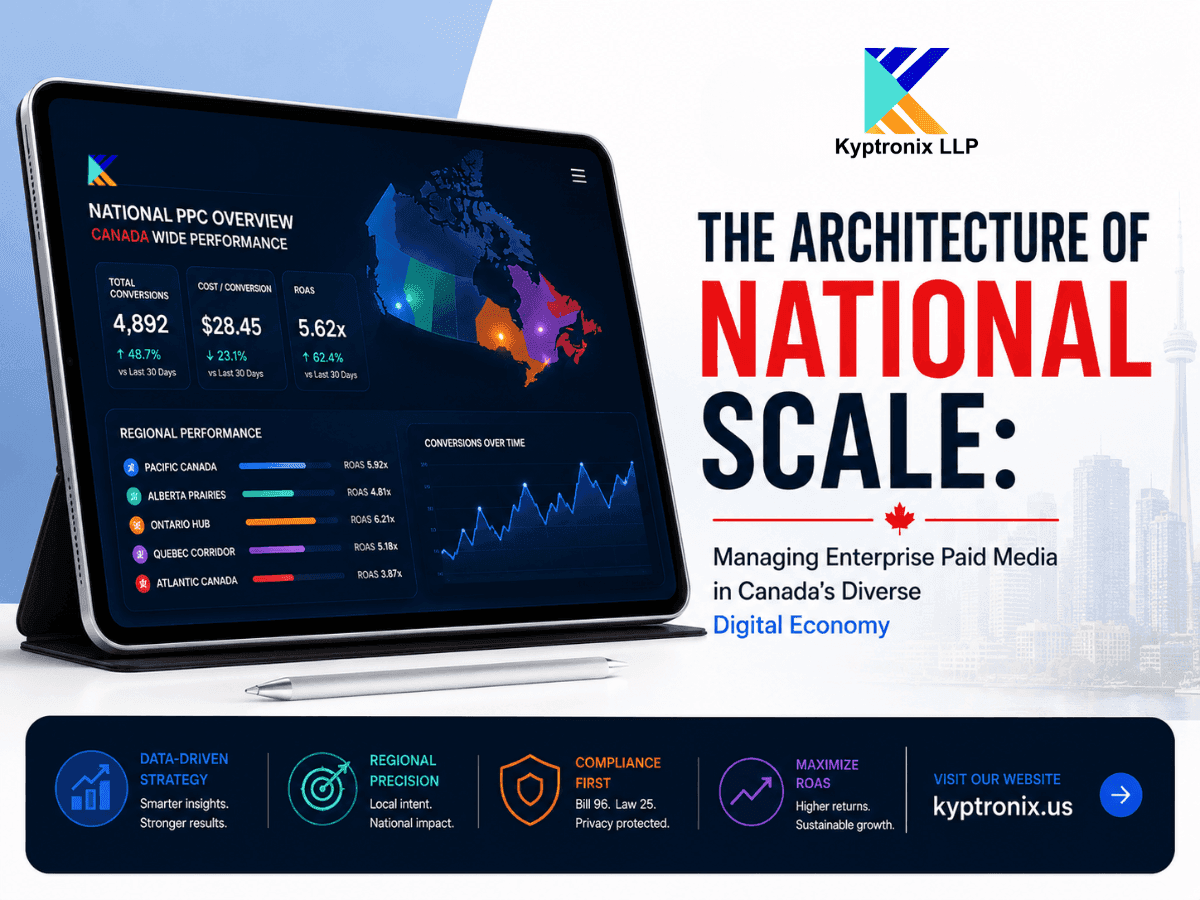
Scaling a digital brand across Canada is a unique operational challenge. Unlike smaller, geographically unified countries, Canada is a sprawling mosaic of distinct regional economies, localized consumer behaviors, six different time zones, and dual-language provincial regulations. A paid search campaign that delivers exceptional returns in downtown Toronto will often completely fall flat when applied to Vancouver's active lifestyle markets or Montreal’s highly localized, francophone digital space.
For mid-market and enterprise-level brands, the default approach to scaling ad spend is often to increase budgets across existing campaigns. However, without a structural strategy for multi-territory pacing, localized bid adjustments, and strict privacy compliance, increasing your spend simply leads to diminishing returns and massive budget waste.
To achieve true national dominance, organizations must shift away from fragmented, localized setups toward structured, high-volume ad management. Partnering with a specialized Pay Per Click Agency in Canada is the definitive first step toward transitioning your enterprise away from reactive ad hoc campaigns into a highly optimized, capital-efficient growth machine built for the unique Canadian market. The flowchart below shows Canada’s Enterprise PPC Architecture:
National Scale Enterprise PPC Architecture: ├── Atlantic Canada (Local Service & Intent Nuances) ├── Quebec Corridor (Mandatory Law 25/Bill 96 Compliance & Transcreation) ├── Ontario Hub (High-Competition, Multi-Segment B2B & Retail Auctions) ├── Prairies / Alberta (Weather-Responsive Scripts & Regional Industry Targeting) └── Pacific Canada (Cascadian Micro-Signals & Mobile Commuter Pacing) |
The Mathematics of Multi-Territory Pacing: Budget Allocation at National Scale
Enterprise paid search campaigns cannot rely on automated single-bucket budget pacing. When you target a vast geography like Canada, Google’s automated algorithms will naturally funnel your budget into the highest-volume, lowest-CPC regions to maximize clicks. Unfortunately, these cheap clicks often come from areas with lower purchasing power or lower lead-to-sale conversion rates, inflating your Customer Acquisition Cost (CAC) while compressing your net profit margins.
To solve this, a specialized provider of Enterprise PPC Management Canada designs a multi-regional budget allocation model. We can mathematically represent this performance optimization target.
If we define R as the set of distinct Canadian regions, we aim to maximize the aggregate net profit (Ⅱ) across all territories by dynamically balancing spend based on regional conversion rates (CRr) and Customer Lifetime Value (LTVr). The optimization function is modeled as:
max Ⅱ = sum ∑Rr=1 (Vr (Spendr) • CRr • LTVr - Spendr) |
Subject to the total national budget constraint:
∑Rr=1 Spendr ≤ BudgetTotal |
And the marginal return boundary for each region:
𝝏Ⅱ ➗ 𝝏Spendr ≥ 𝛄 |
Where:
Vr (Spendr) represents the volume of visitors generated in region r as a function of the localized spend allocated to that territory.
CRr is the localized transaction or lead-to-close conversion rate.
LTVr is the average lifetime value of a customer captured in that specific region.
𝛄 is the minimum acceptable marginal return on ad spend (ROAS) threshold defined by the enterprise.
To execute this mathematical optimization in real-time, performance engineers construct separate, region-specific campaigns rather than pooling all provinces into a single target zone. This allows for precise, manual control over localized bid caps, dayparting schedules, and geographic exclusions, ensuring your capital is consistently directed toward the highest-yielding geographic markets.
Navigating the Canadian Mosaic: Cultural, Linguistic, and Legislative Nuances
Executing high-performing campaigns at a national level requires far more than technical math. It demands a deep respect for provincial cultures and compliance with the law. Canada is not a single, uniform market, and treating it as such is one of the fastest ways to damage your brand's reputation and trigger costly regulatory audits.
1. The Quebec Bilingual Imperative (Bill 96 & Law 25)
Quebec is a highly sophisticated, culturally distinct economic region with its own legal frameworks. Under the strict guidelines of Bill 96, commercial operations targeting consumers in Quebec must provide French communications of equal prominence and quality to any English version. This means your search ads, display creative, product landing pages, and even transactional billing portals must offer native, high-quality French options.
Furthermore, Quebec’s Law 25 represents some of the strictest data-privacy legislation in North America. Mirroring Europe’s GDPR, it mandates that advertisers obtain explicit, active opt-in consent from users before deploying any analytical tracking pixels or remarketing tags.
A premier Pay Per Click Agency in Canada ensures that your ad tech stack is fully updated with Google Consent Mode v2 and OQLF-compliant copy, safeguarding your brand from heavy compliance fines while capturing lower-competition, high-ROI French-language auctions.
2. Time-Zone Coordinated Pacing
Canada spans six different time zones, from Pacific Standard Time (PST) in Vancouver to Newfoundland Standard Time (NST) in St. John's. If your national campaigns are not segmented by time zone, your ad pacing will be completely unbalanced.
An ad scheduled to run during "business hours" (9:00 AM to 5:00 PM) on a single national budget will begin running at 9:00 AM in Newfoundland, which is 4:00 AM in Vancouver. By the time West Coast decision-makers sit down at their desks, a massive portion of your daily budget may already have been exhausted in eastern auctions. Segmenting your campaigns by time-zone clusters ensures your message appears precisely when your target audience is most active and ready to engage.
Enterprise Technical Infrastructure: Server-Side Tagging & First-Party Data
As we navigate a cookieless digital economy, traditional browser-based tracking pixels have become highly inaccurate. With the deprecation of third-party cookies and rising browser-level privacy blocks, such as Apple's Safari ITP, enterprises that rely on standard browser tracking are often operating with up to 30% of their conversion data completely blacked out.
To maintain a competitive edge, a sophisticated partner specializing in National Scale Paid Search transitions your enterprise away from fragile client-side tags toward a robust, server-to-server tracking architecture.
Secure Enterprise Server-Side Tracking Pipeline:
[User Clicks Ad] ──> [Enters Landing Page] ──> [Converts/Fills Form]
│
[Google Ads Server Engine] <── [Server Cloud Container (GCP/AWS)] <── [Secure Encrypted API Payload]
By setting up a private Google Cloud or AWS server container to manage your tracking scripts, you bypass browser-level blocks entirely. This setup collects your first-party conversion data securely, anonymizes personally identifiable information (PII) to remain fully PIPEDA-compliant, and sends clean conversion signals directly back to Google's bidding engine via API.
Furthermore, integrating your internal Customer Relationship Management (CRM) system, such as Salesforce, HubSpot, or Microsoft Dynamics, with your ad account using Offline Conversion Tracking (OCT) allows you to feed closed-deal values directly back into the search engine. This deep-data integration trains the machine learning algorithm to bid aggressively only on search queries that historically lead to signed high-value enterprise contracts, rather than simply chasing cheap form fills.
Optimizing for the Next Generation of Search: AI, GEO, and Responsive Ad Formats
The way consumers search for services online is undergoing a major evolution. With the rise of generative AI search tools and voice-activated digital assistants, users are rapidly shifting away from typing simple, fragmented keywords into traditional search engines. Instead, they are asking highly detailed, conversational questions:
"Which enterprise-grade Canadian logistics provider offers temperature-controlled supply chain tracking between Ontario and BC?"
To ensure your brand remains highly visible in this shifting landscape, your national search campaign structures must be meticulously optimized for Answer Engine Optimization (AEO) and Generative Engine Optimization (GEO).
To meet these next-generation search criteria, your responsive search ads (RSAs), ad extensions, and target landing pages must implement modern semantic standards:
Implement Strict Semantic Hierarchies: Organize your landing page content cleanly using standard header tags (<h1>, <h2>, <section>) so automated AI search crawlers can easily parse your primary value propositions.
Embed Advanced Schema Markup: Integrate comprehensive JSON-LD schema code directly into your website's architecture. This explicitly defines your services, national office locations, and industry authority to search engine crawlers.
Design Conversational FAQ Modules: Incorporate dedicated, direct-answer FAQ sections on your primary service pages that address conversational, high-intent long-tail queries in a clear, authoritative, and helpful voice.
Scale with Absolute Capital Efficiency: Partner with Kyptronix US
Navigating the complexities of multi-regional budget pacing, strict provincial compliance laws, and advanced server-side data integrations requires a strategic partner with deep mathematical expertise, advanced software architecture skills, and real-world enterprise experience. Relying on generic, out-of-the-box software settings or unoptimized automated bidding templates will inevitably limit your company's scalability, dilute your margins, and hurt your bottom line.
This is where Kyptronix US makes the difference. As a leading, results-driven Pay Per Click Agency in Canada, Kyptronix US combines cutting-edge ad tech with deep analytical execution.
The specialized performance engineering team at Kyptronix US doesn't just manage keywords. We construct highly secure, margin-protecting digital acquisition systems. By deploying advanced Enterprise PPC Management Canada frameworks, executing sophisticated National Scale Paid Search campaigns, and building custom server-side data tracking pipelines, we turn search queries into highly profitable revenue streams. Whether you are aiming to deploy compliant multilingual campaigns in Quebec, optimize real-time weather-responsive bidding in the Prairies, or capture high-value enterprise contracts nationwide, Kyptronix US provides the data-backed execution needed to lead your industry.
Ready to stop the budget bleed and scale your enterprise with absolute capital efficiency? Discover how the expert performance engineers at Kyptronix US can transform your paid search presence into an active growth engine today.
Frequently Asked Questions (FAQs)
1. Why does our business need a specialized Pay Per Click Agency in Canada?
A specialized national partner understands the unique geographical, cultural, and regulatory nuances of the Canadian market. They ensure your campaigns are segmented correctly by time zones, comply with strict provincial privacy laws, and target high-value local audiences without wasting budget on low-converting search queries.
2. What is Enterprise PPC Management Canada, and how does it differ from standard PPC?
Enterprise PPC management involves handling high-volume ad budgets, complex multi-region campaign architectures, advanced server-side data integrations, and first-party CRM tracking. It focuses on maximizing Return on Ad Spend (ROAS) across diverse national territories rather than simple traffic acquisition.
3. How does Canada's PIPEDA legislation impact paid search campaigns?
PIPEDA (Personal Information Protection and Electronic Documents Act) regulates how businesses collect, use, and protect consumer data. Paid search campaigns must utilize privacy-compliant tracking architectures, anonymous data collection methods, and secure server-to-server data pipelines to remain fully compliant.
4. What is National Scale Paid Search, and how do we prevent budget dilution?
It refers to executing unified search campaigns across Canada's six time zones. To prevent budget dilution, we build region-specific campaigns with independent budgets, localized bid adjustments, and tight negative keyword libraries, rather than pooling all provinces into a single target zone.
5. How do Quebec's Law 25 and Bill 96 affect digital advertising?
Bill 96 requires commercial communications targeting Quebec consumers to offer native, high-quality French options. Law 25 mandates that advertisers obtain explicit, active opt-in consent from users before deploying any tracking cookies or marketing pixels on their web browsers.
6. What is Server-Side Tagging, and why is it useful for enterprise campaigns?
Server-side tagging manages your tracking scripts through a secure, private cloud server instead of a user's web browser. This bypasses ad-blockers and privacy blockers, keeps your customer data highly secure, and sends clean, accurate conversion signals directly to your ad platforms via API.
7. How does Offline Conversion Tracking (OCT) help optimize my ad spend?
OCT integrates your CRM software directly with your paid search accounts, allowing you to communicate final sales values back to the ad network. This trains the smart bidding algorithm to focus your budget on search queries that lead to closed deals, rather than simply chasing cheap form fills.
8. What is Google Consent Mode v2, and why is it necessary?
Google Consent Mode v2 is a privacy framework that adjusts how Google tags behave based on a user's cookie consent choice. Complying with this framework in Canada ensures your analytics remain highly accurate and legally compliant with modern privacy acts.
9. Can weather patterns actually impact paid search performance in Canada?
Yes. Regional weather patterns, such as Alberta’s Chinooks, sudden prairie blizzards, or heavy West Coast rains, directly influence search volumes for home services, automotive detailing, and logistics. Advanced campaigns use automated scripts to raise bids during these peak weather events.
10. How long does it typically take to see results from a national enterprise PPC campaign?
While paid ads generate traffic almost immediately, optimizing a national campaign to its peak efficiency, including setting up server-side data integration, training bidding algorithms, and refining regional bid weights, typically takes 30 to 90 days.