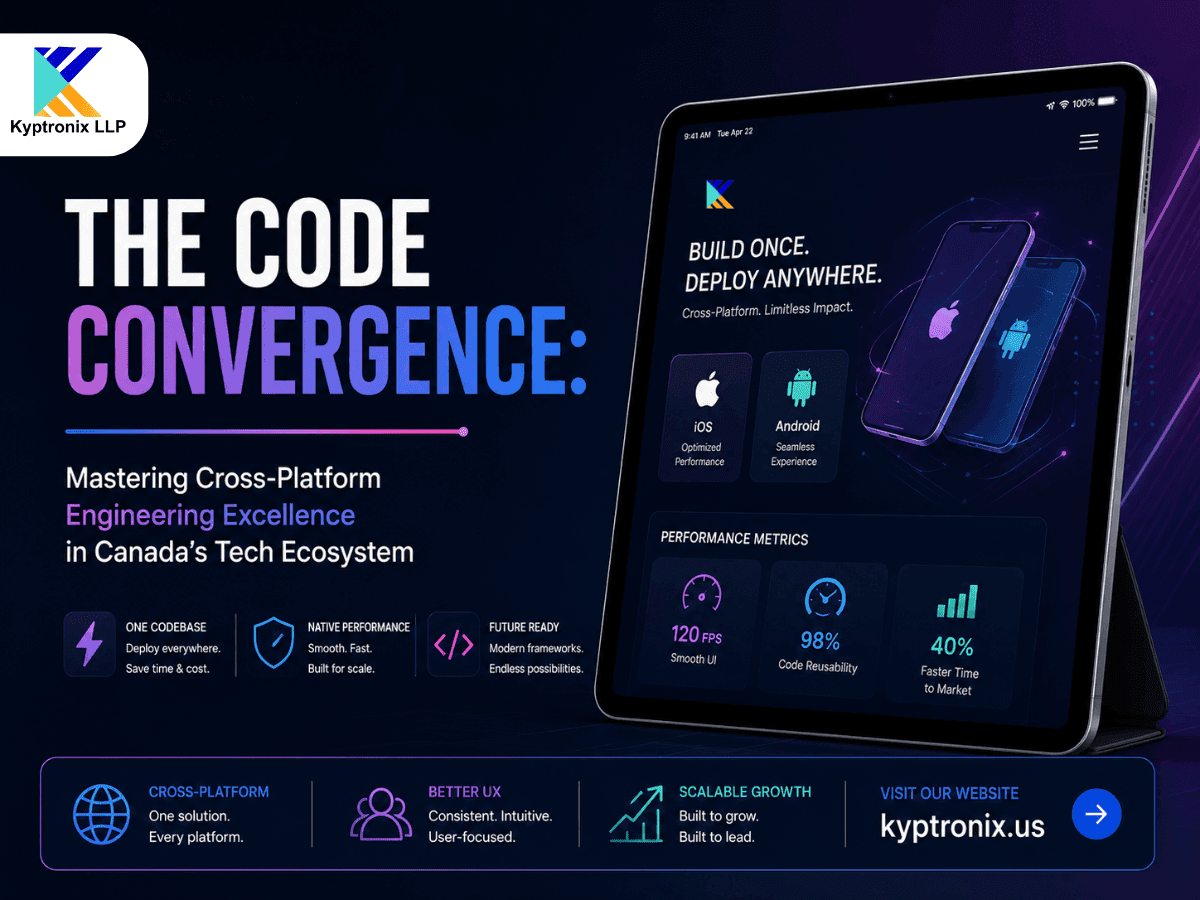
Imagine standing at the edge of a massive product launch. Your marketing strategy is locked, your market validation is complete, and your target audience across Canada is primed to download your new application. But behind the scenes, your development team is fighting a quiet, exhausting war. They are struggling to maintain parity between two entirely separate codebases: one written in Swift for iOS, and another in Kotlin for Android. Feature updates take twice as long, bug fixes are duplicated, and your customer acquisition budget is slowly being consumed by parallel software maintenance.
For scaling Canadian enterprises, this scenario is a common operational bottleneck. Maintaining native twin codebases is a massive, ongoing tax on corporate agility.
To break free from this cycle, forward-thinking CTOs and product owners are shifting toward modern cross-platform frameworks. In 2026, building a cross-platform app is no longer about accepting slow loading speeds or clunky user interfaces. By partnering with a premier Top Mobile App Dev in Canada, you can leverage advanced engineering paradigms to build singular, high-performance codebases that run natively on any device. Let’s explore the architectural structures, performance metrics, and compliance guidelines that define modern cross-platform engineering.
The Great Architectural Leap: Bypassing the Bridge
To understand why a leading provider of Enterprise App Development Services Canada advocates for cross-platform solutions today, we must look at how the underlying technology has evolved.
Historically, hybrid frameworks, such as Cordova and early PhoneGap, relied on web-view wrappers. They essentially loaded a lightweight browser inside a native shell. These platforms suffered from high input latency, slow rendering times, and poor access to local device hardware.
Modern Cross-Platform Mobile App Development has completely bypassed these limitations. Instead of wrapping web code, modern frameworks compile directly to native machine code or draw pixels directly onto the screen using high-speed rendering engines.
The Legacy Asynchronous Bridge vs. Modern Native Compilation:
[Legacy Model]   ──> [JS Layer] ──> (JSON Serialization Bridge) ──> [Native UI API] (High Latency)
[Modern Model]   ──> [Dart/JS]   ──> (Direct JSI / C++ Compilation) ──> [Direct GPU Canvas] (Instantaneous)
1. React Native and the JavaScript Interface (JSI)
In its original iteration, React Native relied on a serialize/deserialize JSON bridge to communicate between JavaScript and the native threads. This bridge acted as a digital bottleneck, slowing down UI transitions and heavy data transfers.
The framework's modern architecture eliminates this bridge. It replaces it with the JavaScript Interface (JSI). Written in C++, JSI allows the JavaScript engine to hold direct references to native host objects. This means methods on the native side can be invoked synchronously, enabling smooth, near-instantaneous UI rendering and animations that easily run at 120Hz on modern displays.
2. Flutter and the Impeller Rendering Engine
Flutter takes an entirely different, highly disruptive approach. It bypasses the platform’s native UI components altogether. Instead, it draws every button, text block, and transition directly onto an internal canvas.
Historically, Flutter used the Skia graphics engine, which occasionally suffered from "shader compilation jank," minor, brief frame rate drops when an animation was rendered for the very first time. In 2026, Flutter will have fully transitioned to the Impeller rendering engine. Engineered specifically for modern graphics APIs, like Metal on iOS and Vulkan on Android, Impeller pre-compiles shaders during build time, eliminating jank and ensuring your application renders at a flawless, native-grade speed from the very first tap.
The Mathematics of Rendering: Quantifying UI Performance
In professional software development, user experience is measured in milliseconds. High-refresh-rate displays (now standard across modern smartphones) require a frame to be rendered and pushed to the screen every 8.33 milliseconds to maintain a smooth 120 FPS output.
To understand the mathematical efficiency of modern cross-platform architectures, we can model the total frame render latency (Lr) of a user interface. Let TGPU represent the GPU drawing execution time, Tthread represent the CPU thread-dispatching overhead, and Tbridge represent the communication latency between your logical codebase and the native host system. We express this relationship through the following formula:
Lr = TGPU + Tthread + Tbridge |
If Lr exceeds the system refresh boundary (Brefresh), a frame is dropped, resulting in noticeable UI stutter. Under legacy bridge-based frameworks:
Tbridge ≫ 2.0 ms |
This left almost no margin for complex animations or heavy background calculations on the CPU thread, frequently causing Lr > 8.33 ms.
By deploying modern Cross-Platform Mobile App Development architectures, such as JSI-enabled React Native or Flutter’s compiled Impeller code, Tbridge is effectively reduced to zero:
Tbridge ≈ 0 |
This optimization ensures that:
Lr ⫹ Brefresh |
Even during complex, high-concurrency UI actions, cross-platform apps achieve performance metrics that are virtually identical to natively compiled Swift or Kotlin apps.
Navigating the Canadian Regulatory Landscape: Privacy & Data Security
A beautiful, lightning-fast application is only successful if it can protect customer data and satisfy strict legal frameworks. Canada enforces some of the most rigorous data privacy legislation in the world, and failure to design your app’s data pipeline around these rules can result in heavy corporate fines.
Any mobile product engineered for the Canadian market must adhere to three key legislative frameworks:
1. PIPEDA Compliance (Federal)
The Personal Information Protection and Electronic Documents Act (PIPEDA) governs how private-sector organizations collect, use, and disclose personal information. Your mobile application’s technical architecture must implement strict data minimization principles. It must collect only the essential telemetry needed to operate, encrypt personal data both in transit and at rest using modern standards, such as AES-256, and offer transparent, easily accessible opt-out controls for tracking networks.
2. Provincial Privacy Laws (BC PIPA & Alberta PIPA)
If your user base is concentrated in British Columbia or Alberta, your platform must align with the provincial Personal Information Protection Acts (PIPA). These laws establish strict rules regarding consent. The user must consent explicitly and actively before any data collection can occur, meaning default opt-in or hidden consent checkboxes in a long-term terms-of-service document will not satisfy local compliance audits.
3. Quebec’s Law 25
Quebec’s Law 25 represents some of the strictest data-privacy legislation in North America. Mirroring Europe’s GDPR, it mandates that organizations must design their digital products to be "privacy-first by default."
If your app collects, logs, or tracks geolocation, device IDs, or behavioral analytics of Quebec citizens, the user must be presented with an explicit, clear opt-in prompt. Furthermore, you must provide users with an easy way to request the complete deletion of their stored data profile, i.e., the right to be forgotten, directly from the mobile app interface.
Canadian Mobile Compliance Framework:
├── Federal (PIPEDA) ──────────> Data minimization, strong AES-256 encryption at rest/transit
│
├── Western Canada (BC/AB PIPA) ─> Active, unprompted user consent for personal profiles
│
└── Eastern Canada (QC Law 25) ──> Privacy-by-default, explicit tracking opt-ins, right to be forgotten
Scaling Safely: The ROI of Cross-Platform Engineering
To understand why partnering with a premier Top Mobile App Dev in Canada is a strategic business decision, we must analyze the economic return on investment.
Launching a digital product involves two major financial phases: initial development and long-term maintenance. In a native twin-codebase model, your development costs are doubled from day one. You require separate teams of iOS and Android specialists, separate code reviews, and separate Quality Assurance (QA) testing cycles.
Twin-Codebase Lifecycle Costs:
[Swift Codebase] ──> Separate QA ──> Parallel Feature Updates ──> Doubled Maintenance Overhead
[Kotlin Codebase] ──> Separate QA ──> Parallel Feature Updates ──> Doubled Maintenance Overhead

Cross-Platform Lifecycle Costs:
[Shared Codebase] ──> Unified QA ──> Synchronized Updates ──────> Highly Efficient Scale
More importantly, your long-term maintenance costs (which typically consume 15% to 20% of your initial software budget annually) scale in parallel. If a critical API endpoint updates or a new iOS version introduces a breaking bug, both codebases must be updated, tested, and submitted to their respective app stores independently.
By consolidating your engineering resources into a single, highly optimized cross-platform codebase, you achieve massive operational efficiencies:
Synchronized Feature Parity: New product updates, promotional offers, or security patches are deployed to both the Apple App Store and Google Play Store simultaneously, ensuring a uniform brand experience for all users.
Highly Efficient QA Cycles: Your testing team only needs to validate a single core logical codebase, allowing them to focus on deep edge-case testing and UX polishing rather than duplicating basic functional tests.
Halved Technical Debt: Refactoring and restructuring code is simplified, allowing your engineering talent to focus on innovation rather than duplicating maintenance tasks.
Co-Architecting Your Mobile Future with Kyptronix US
Navigating the complexities of modern system architectures, high-performance rendering pipelines, and Canada's rigorous privacy regulations requires a strategic partner with deep technical expertise and real-world business integration experience. Relying on basic, out-of-the-box software templates or standard web development agencies will inevitably limit your system's scalability, increase technical debt, and compromise your data security.
This is where Kyptronix US makes the difference. As a leading, results-driven technology partner, Kyptronix US combines advanced mobile engineering with deep analytical execution.
The specialized engineering team at Kyptronix US doesn't just write code. We design highly secure, margin-protecting digital assets. By deploying bespoke Enterprise App Development Services Canada frameworks, executing sophisticated Cross-Platform Mobile App Development campaigns, and building secure server-to-server data tracking pipelines, we turn user interfaces into active growth drivers for your business. Whether your goal is to launch a compliant, bilingual application across Canada, optimize real-time data synchronization for complex supply chains, or scale a highly interactive consumer product, Kyptronix US provides the data-backed execution needed to lead your industry.
Ready to stop the budget bleed and scale your digital presence with absolute capital efficiency? Discover how the expert engineers at Kyptronix US can transform your mobile platform into a high-performance business asset today.
Frequently Asked Questions (FAQs)
1. Why should my company hire a specialized Top Mobile App Dev in Canada?
A specialized local partner understands the unique geographical, technical, and regulatory requirements of the Canadian marketplace. They ensure your mobile application compiles smoothly, performs flawlessly across diverse user devices, and remains fully compliant with provincial and federal privacy legislations like PIPEDA.
2. What is Cross-Platform Mobile App Development, and how does it save on costs?
It is the practice of writing a single, unified codebase that can be compiled natively to run on both iOS and Android platforms. It slashes initial development costs by up to 45% and dramatically simplifies long-term maintenance by eliminating the need to update parallel native codebases.
3. How does modern cross-platform performance compare to native development?
With modern architectural frameworks like React Native's JavaScript Interface (JSI) and Flutter's compiled Impeller graphics engine, the performance gap between native and cross-platform has effectively been closed. Apps load instantly, animations render smoothly at 120Hz, and native device hardware is accessed with near-zero latency.
4. What are Enterprise App Development Services Canada, and how do they benefit scaling brands?
Enterprise development services focus on building highly secure, scalable, and resilient mobile applications capable of integrating seamlessly with complex back-end systems, such as legacy ERPs, CRMs, and secure cloud databases. They prioritize advanced state management, strict security protocols, and compliance metrics to support high-concurrency traffic.
5. How does Quebec's Law 25 impact mobile apps targeting Canadian users?
Law 25 requires that applications place user privacy first by default. Users must actively opt in before you can deploy any analytical tracking pixels or collect device IDs. Additionally, apps must provide a clear, easy way for users to request the permanent deletion of their personal profiles.
6. What is the difference between React Native and Flutter?
React Native compiles JavaScript code to native UI elements, making it ideal for apps that rely heavily on native platform integrations and shared web logic. Flutter compiles Dart code directly to machine code and draws its own UI elements via its graphics engine, guaranteeing highly customized and visually consistent interfaces across all devices.
7. Can a cross-platform mobile application work seamlessly offline?
Yes. By deploying advanced local database frameworks, such as SQLite, Realm, or WatermelonDB, and setting up secure, offline-first data synchronization layers, your application can store user actions locally and sync them automatically with your cloud servers once an internet connection is re-established.
8. How do we ensure our mobile app complies with Canada’s PIPEDA regulations?
To comply with PIPEDA, you must implement strong AES-256 data encryption for data in transit and at rest, limit the collection of personal information to only what is strictly necessary, provide transparent privacy policies, and regularly audit your data storage pathways.
9. What is the role of the JavaScript Interface (JSI) in React Native?
JSI is a modern C++ engine wrapper that allows JavaScript code to directly interact with native host APIs without relying on an asynchronous JSON bridge. This synchronous communication eliminates communication bottlenecks, ensuring ultra-low latency for UI transitions and calculations.
10. How long does it typically take to develop a custom enterprise mobile app?
While timelines vary based on feature set and integration complexity, a standard Proof of Concept (PoC) can typically be designed and tested within 8 to 12 weeks. Full-scale production deployment, including rigorous QA testing, compliance audits, and App Store submission, generally takes 6 to 12 months.