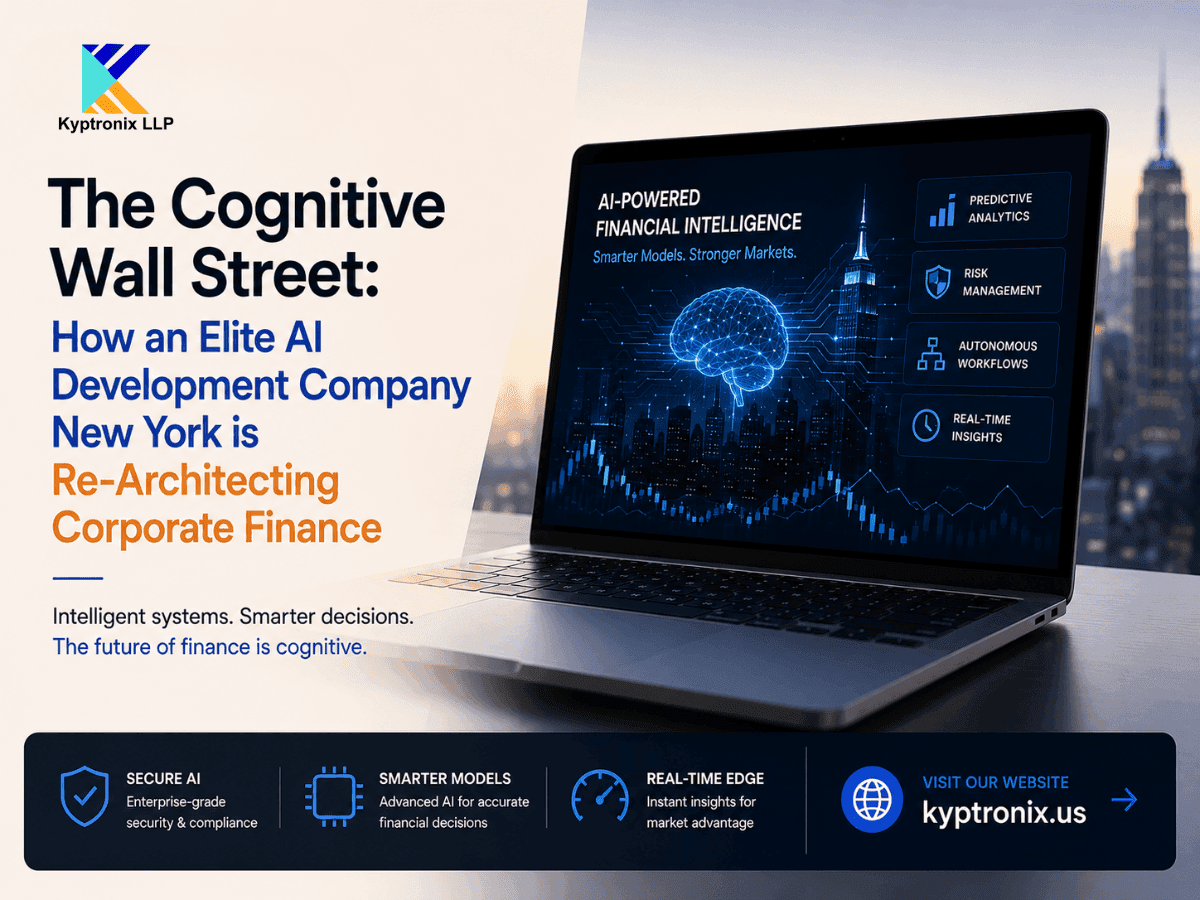
New York City has always been the undisputed nervous system of global capital. From the high-frequency trading desks of Lower Manhattan to the glass-and-steel corporate headquarters lining Midtown, the city thrives on speed, risk management, and the relentless pursuit of competitive leverage. Today, however, New York's financial and corporate sectors are undergoing a profound, structural evolution. The traditional software systems that powered the banking boom of the last two decades are being replaced by active, self-orchestrating cognitive networks.
As highlighted by thousands of engineers, founders, and enterprise leaders during the citywide AI Week New York 2026 festival, the era of treating artificial intelligence as a passive "chatbot helper" is officially over. We have entered the era of Agentic AI. Today, forward-thinking enterprise leaders are no longer asking how to summarize a PDF. They are asking how to build secure, autonomous workflows that can orchestrate multi-step financial processes, analyze volatile market variables in real-time, and execute transactions without manual intervention.
To safely navigate this technical shift, corporate leaders must build on secure, custom-tailored code architectures. Partnering with a premier AI Development Company New York is the definitive first step toward transitioning your legacy systems into margin-protecting, highly automated cognitive assets.
The New Core of Capital: Why Wall Street is Moving to Agentic AI
Historically, financial institutions could maintain an edge simply by deploying faster fiber-optic cables or scaling up traditional quantitative models. Today, the competitive differentiator is the speed and accuracy of operational intelligence. According to the comprehensive 2026 Global AI in Financial Services Report published by the Cambridge Centre for Alternative Finance, an astronomical 81% of financial services firms have adopted AI at some level. Furthermore, 52% of these industry leaders are actively deploying agentic workflows.
What makes agentic systems so disruptive to the legacy landscape? While standard generative tools require constant human prompts to perform individual tasks, agentic architectures can plan, reason, call external APIs, self-correct their logic, and interact directly with secure financial clearing networks.
Legacy Automated Systems vs. Agentic FinTech Workflows:
[Legacy Rules-Engine] ──> (Siloed If/Then Alerts) ──> [Manual Risk Curation] →↓
[Slower Decision]   ← ↓
[Agentic AI Loop] ──> (Real-Time Multi-Signal Analysis) ──> (Self-Executed Optimization) → ↓
[Instant ROI]   ← ↓
Within the high-volume digital payments segment, which accounts for nearly 24% of the entire fintech market space, artificial intelligence is heavily concentrated in real-time fraud mitigation and transaction routing optimization. By working with a specialized provider of FinTech AI Solutions New York, banks and fintech operators are deploying systems that evaluate transaction anomalies within microseconds, shielding their operations from sophisticated cyber threats and structural margin loss.
The Anatomy of Corporate AI Integration: From Pilot to Production
Integrating high-performance machine learning models within a regulated corporate structure is a complex, multi-tiered engineering challenge. Financial firms operate under intense regulatory scrutiny. Algorithms must be transparent, audit-ready, and entirely explainable to satisfy federal compliance mandates.
This is where a strategy of custom Enterprise AI Integration NYC becomes an invaluable operational safeguard. To prevent mathematical hallucinations and guarantee consistent outputs, developers build multi-layered validation structures.
For instance, in real-time risk assessment, deep learning models evaluate transaction parameters by projecting them into multi-dimensional vector spaces. To calculate the statistical probability of transaction fraud dynamically, modern risk engines employ a logistic regression function wrapped around multivariate anomaly indicators:
P(Fraud │ X) = 1 ➗ 1 + e-(𝛃TX+𝛄•AnomalyScore) |
Where:
X represents the multi-dimensional vector of real-time transactional features, such as transfer velocity, historical spending bounds, and geographic routing distance.
𝜷T represents the transposed weight matrix calculated during the model's localized training phase.
AnomalyScore is the real-time distance value generated by deep-isolation forest algorithms operating on edge nodes.
𝛄 is the regulatory scaling factor used to adjust system sensitivity based on current institutional risk tolerance profiles.
By deploying custom FinTech AI Solutions New York, financial engineers ensure that these complex equations run at scale under ultra-low latency, blocking fraudulent activity at the point of origin while preserving a seamless, low-friction experience for verified users.
The Empire AI Era: Infrastructure and Governance in New York State
The acceleration of enterprise artificial intelligence requires an immense amount of physical computing infrastructure. In New York, this digital buildout has become a major legislative and economic priority. Under the leadership of Governor Kathy Hochul, the state has launched the pioneering Empire AI initiative, a nation-leading public-private consortium designed to accelerate safe, ethical, and highly secure AI research.
However, as the demand for hyperscale data centers surges across the state, businesses must adapt to strict local environmental, energy, and security regulations. Deploying unguided, off-the-shelf public APIs presents severe operational risks, including data leaks, intellectual property exposure, and compliance failures under SOC 2 rules.
Secure Multi-Tier Corporate AI Architecture:
├── Private Enterprise Cloud (AWS, Azure, GCP, or On-Premises Servers)
│   ├── Secure Vector Databases (Pinecone, Qdrant, Milvus) ──> Fully Encrypted Local Storage
│   │
│   └── Specialized Open-Source LLMs (Llama 3.1, Mistral) ────> Fully Containerized Environments
│
└── Active Semantic Guardrails (NeMo Guardrails, Custom Validator APIs) ──> PII Anonymization
To achieve absolute compliance, a top-tier AI Development Company New York transitions enterprises away from commodity public APIs toward secure, private cloud environments. By containerizing open-source foundation models and deploying secure, local Retrieval-Augmented Generation (RAG) pipelines, companies can leverage the power of cognitive computing while ensuring their proprietary IP and client financial records remain fully protected within private corporate boundaries.
Quantifying the ROI: Redesigning the SDLC and Operational Pacing
In a tightening macroeconomic environment, capital allocation must be justified by a clear, measurable return on investment. The transition to agentic enterprise software is already showing massive bottom-line impacts. According to industry statistics, AI-centric corporate organizations are achieving a 20% to 40% reduction in overall operating costs, hence significantly increasing the EBITDA margins, driven by faster software delivery and highly optimized cycle times.
Furthermore, industry analysts at Gartner project that by the end of 2026, over 40% of enterprise software applications will feature task-specific AI agents, up from less than 5% just a year prior.
This evolutionary shift is completely rewriting the Software Development Lifecycle (SDLC). By automating repetitive coding tasks, unit testing, and continuous deployment tracking, senior developers are freed to focus entirely on high-level system design, strategic oversight, and robust security governance. Embracing custom Enterprise AI Integration NYC allows your business to scale its engineering capacity and innovate faster, creating a compounding market advantage that latecomers will struggle to match.
Co-Architecting Your AI Future with Kyptronix US
Navigating the highly complex, shifting intersection of cognitive software development and regulatory compliance requires a strategic partner with deep mathematical expertise, advanced system architecture skills, and real-world business integration experience. Relying on generic templates or unoptimized public APIs will inevitably limit your system's scalability, increase latency, and introduce severe data security risks.
This is where Kyptronix US makes the difference. As an elite, results-driven AI Development Company New York, Kyptronix US combines cutting-edge machine learning technology with secure, enterprise-grade software execution.
The specialized engineering team at Kyptronix US doesn't just write code. We design highly secure, margin-protecting digital assets. By deploying bespoke FinTech AI Solutions New York, engineering advanced Enterprise AI Integration NYC platforms, and building custom RAG pipelines, we turn raw corporate data into your most powerful engine for growth. Whether you are aiming to deploy autonomous transaction agents, automate complex compliance workflows, or protect your proprietary intellectual property within a private cloud, Kyptronix US provides the data-backed execution needed to lead your industry into the cognitive era.
Ready to stop experimenting and start executing at scale? Discover how the expert performance engineers at Kyptronix US can transform your corporate workflows and build your custom AI future today.
Frequently Asked Questions (FAQs)
1. Why does my Manhattan business need a specialized AI Development Company New York?
A specialized local partner understands the unique regulatory, economic, and security demands of the New York corporate and financial markets. They ensure your custom models are built securely, comply with local data mandates, and integrate seamlessly with your existing enterprise infrastructure.
2. What is the difference between Generative AI and Agentic AI?
Generative AI focuses on passive task completion, such as writing text or answering a direct prompt. Agentic AI refers to autonomous systems designed to plan, execute multi-step workflows, call external APIs, and self-correct their errors to achieve complex business goals without constant human intervention.
3. How does custom Enterprise AI Integration NYC protect proprietary corporate data?
By avoiding public APIs and instead containerizing open-source models within secure, private cloud environments, such as AWS or Azure, or on-premise servers, custom integration ensures that your company's proprietary IP and private customer data never leave your secure corporate boundaries.
4. How are FinTech AI Solutions New York changing real-time fraud detection?
Modern fintech solutions use deep learning algorithms to analyze transaction parameters in microseconds. By instantly calculating multivariate risk scores and anomaly indicators, these systems block fraudulent activity at the point of origin without adding friction to legitimate user transactions.
5. What is the "Empire AI" initiative launched in New York?
Empire AI is a nation-leading public-private consortium and state-funded initiative championed by Governor Kathy Hochul. It is designed to accelerate secure, ethical AI research, innovation, and economic development across New York State.
6. Why should financial institutions choose custom AI over off-the-shelf SaaS products?
Off-the-shelf SaaS products are often built on public, one-size-fits-all APIs that present severe data privacy risks, lack custom workflow adaptability, and cannot guarantee the strict explainability and transparency required by financial regulators.
7. What is Retrieval-Augmented Generation (RAG) and why is it useful?
RAG is an architectural pattern that connects your AI model directly to your internal corporate knowledge bases, databases, and legacy systems. This allows the model to query real-time, verified files to generate highly accurate, citation-backed responses, drastically reducing hallucinations.
8. How does AI integration impact the Software Development Lifecycle (SDLC)?
AI-augmented development automates repetitive coding tasks, unit testing, and initial spec synthesis. This reduces software delivery cycles and frees senior engineering talent to focus on system-level architecture, security auditing, and product innovation.
9. What are the top operational risks associated with corporate AI deployment?
The primary operational risks include lack of model explainability, operational resilience failures, adversarial cyber threats, data security leaks, and algorithmic bias. These risks are mitigated by implementing robust, custom semantic guardrails and continuous model auditing.
10. How long does a typical custom enterprise AI development project take?
A basic Proof of Concept (PoC) to validate data pipelines and test initial model performance can typically be designed and tested within 8 to 12 weeks. Full enterprise production deployment, including legacy system integrations and compliance audits, generally takes 6 to 12 months.