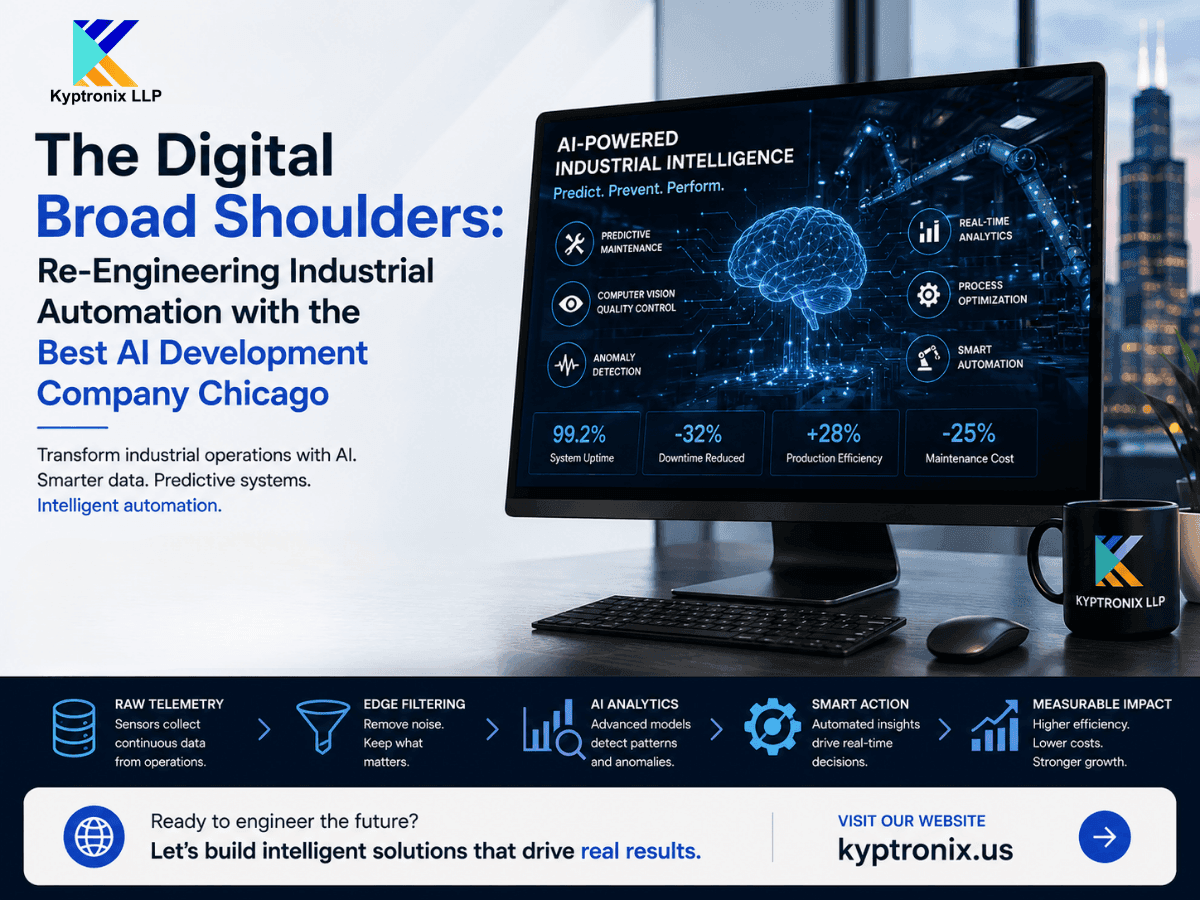
More than a century ago, the poet Carl Sandburg famously immortalized Chicago as the "Hog Butcher for the World, Tool Maker, Stacker of Wheat, Player with Railroads and the Nation's Freight Handler." It was a tribute to a city built on physical grit, massive manufacturing systems, and complex supply logistics. Today, those same broad shoulders are carrying Chicago into a new era. The physical grit of the industrial age is merging with the intellectual caliber of the cognitive era.
Across the Midwest, factory floors, distribution hubs, and processing plants are undergoing a quiet, structural revolution. We are no longer simply automating physical motion. We are automating operational intelligence. The challenge for modern industrial leaders has shifted from "how do we move physical goods faster?" to "how do we harness the petabytes of unstructured telemetry generated by our systems every single day?"
For businesses looking to survive and dominate this hyper-competitive shift, the answer lies in partnering with an elite AI Development Company Chicago. By converting raw, unorganized "dark data" into clean, active predictive engines, companies are transforming their physical operations into highly intelligent, self-optimizing ecosystems.
From Dark Data to Smart Data: Unleashing the Power of Industrial Telemetry
Walk into any modern manufacturing plant or logistics center in the Chicago metropolitan area, and you will find thousands of Internet of Things (IoT) sensors measuring temperature, vibration, acoustics, and pressure. Yet, according to industrial data studies by McKinsey & Company, up to 90% of the sensor data generated is classified as "dark data," that is, collected, stored briefly, and then discarded without ever being analyzed.
This is an enormous missed opportunity. Raw telemetry is the lifeblood of modern industrial optimization, but it requires sophisticated processing to become useful. This is where Smart Data Analytics Chicago becomes a critical operational asset.
Industrial Data Transformation Pipeline:
[Raw Telemetry] ──> [Edge Filtering] ──> [Feature Extraction] ──> [Multivariate AI Model] ──> [Automated Real-Time Action]
To transform raw telemetry into highly actionable "smart data," machine learning engineers deploy advanced multivariate anomaly detection models. Instead of looking at a single sensor in isolation, such as tracking temperature alone, modern neural networks evaluate how hundreds of distinct physical variables interact simultaneously.
To calculate this multidimensional alignment and spot microscopic signs of equipment wear before a physical breakdown occurs, developers measure the statistical distance of multivariate sensor readings. The standard mathematical metric used to detect these anomalies is the Mahalanobis Distance, calculated using the following formula:
DM (x) = √( x - 𝝁 )T ∑-1 ( x - 𝝁 )
Where:
x represents the multivariate vector of real-time sensor readings (e.g., simultaneous measurements of temperature, vibration, and pressure).
𝝁 represents the mean vector of those same physical variables compiled under ideal, normal operating conditions.
∑-1 represents the inverse covariance matrix, which accounts for the statistical relationships and dependencies between different sensors.
By implementing these advanced statistical models, a specialized AI Development Company Chicago can help your business identify subtle machine variations that human operators or basic threshold alerts would completely miss, turning raw data into an active shield against unplanned operational downtime.
Re-Engineering the Factory Floor: Predictive Maintenance & Vision-Based Quality Assurance
When an industrial machine breaks down unexpectedly on a production line, the financial impact is immediate and compounding. According to research by the International Society of Automation (ISA), unplanned downtime costs global manufacturers an estimated 50 billion dollars annually. For a local mid-sized manufacturing plant, a single day of system failure can result in hundreds of thousands of dollars in lost yield and rushed supply logistics.
Implementing specialized Enterprise AI Solutions Chicago shifts your operations from a reactive "break-fix" cycle to a highly predictive, preventative maintenance schedule.
Predictive vs. Reactive Operational Curve:
[Reactive: Run to Failure] ──> (Catastrophic Stop) ──> (High Repair Cost & Delay)
[Predictive: Sensor Drift] ──> [AI Anomaly Detection] ──> (Scheduled Low-Cost Intervention)
Beyond monitoring machine health, artificial intelligence is also redefining quality control through automated computer vision. Traditional manual inspections are slow, subject to human fatigue, and difficult to scale on high-speed production lines. Modern convolutional neural networks (CNNs), however, can inspect thousands of physical components per minute as they move along a conveyor belt.
These vision systems are trained to detect microscopic structural cracks, surface blemishes, or dimensional errors with millimeter-level precision. When a defect is spotted, the system instantly triggers an automatic pneumatic sorting arm to remove the compromised part, while logging the specific defect pattern to alert production engineers of potential tooling misalignments upstream.
The Architecture of Real-Time Intelligence: Edge AI vs. Cloud Orchestration
To build an industrial automation framework that scales successfully, your system architecture must balance processing speed with computational power. In a manufacturing environment, latency is everything. If an automated safety valve or a robotic cutting arm relies on a cloud-based AI model to decide when to stop, a minor network delay can result in catastrophic equipment damage or severe worker injury.
To solve this latency challenge, modern industrial architectures leverage a hybrid design that distributes processing between local Edge Devices and central Cloud Platforms, as shown in the flowchart below:
Distributed Industrial AI Architecture:
├── Edge Layer (On-Device Inference) ──> Low Latency, Real-Time Safety, Anomaly Filtering (Microcontrollers/TPUs)
└── Cloud Layer (Global Training) ──────> Heavy Computing, Retraining Models, Long-Term Fleet Analytics
At the local level, lightweight, optimized models are deployed directly onto on-site microcontrollers and Tensor Processing Units (TPUs) on the factory floor. These Edge AI systems run inference locally in microseconds, ensuring real-time machine safety and immediate operational adjustments without relying on an active internet connection.
Meanwhile, the centralized Cloud Platform acts as the system's brain. It aggregates filtered data from across your entire fleet of machines to retrain models, run heavy deep-learning computations, and provide executive-level operational dashboards. Partnering with a team that has deep expertise in custom software architecture ensures that your edge-to-cloud data pathways remain fast, secure, and resilient against network outages.
Overcoming the Legacy Hurdle: Integrating AI with SCADA and PLCs
One of the biggest practical hurdles preventing industrial companies from adopting modern artificial intelligence is the presence of legacy hardware. Many factory floors and logistics hubs run on decades-old Supervisory Control and Data Acquisition (SCADA) systems, Programmable Logic Controllers (PLCs), and outdated manufacturing execution software.
These legacy systems use old, industrial communication protocols, such as Modbus, Profibus, or OPC UA, that were never designed to share data with modern, cloud-native machine learning models.
To bridge this protocol gap, specialized engineers build custom middleware and industrial gateway solutions. These gateways translate raw, low-level PLC register data into clean, structured JSON payloads that can be easily consumed by modern RESTful APIs or real-time streaming tools like Apache Kafka. The flowchart below explains the same:
Industrial Data Translation Layer:
[Legacy PLC / SCADA (Modbus)] ──> [Custom Industrial Gateway] ──> [Structured JSON/Kafka Stream] ──> [Real-Time AI Model]
By establishing this reliable translation layer, you can breathe new life into your existing machinery, allowing you to harvest high-value telemetry and deploy modern predictive models without needing to completely replace your multi-million-dollar physical infrastructure.
Choosing a Strategic Growth Engine: Kyptronix US
Navigating the complexities of modern machine learning and industrial automation requires a rare combination of deep mathematical expertise, advanced system design, and hands-on operational understanding. Trying to implement these complex systems using generic, pre-built software templates or standard web development agencies will inevitably limit your system performance and create security risks.
This is where Kyptronix US makes the difference. As a leading, results-driven AI Development Company Chicago, Kyptronix US bridges the gap between theoretical data science and reliable, industrial-grade software execution.
The engineering team at Kyptronix US specializes in designing, auditing, and scaling custom intelligent solutions for the modern industrial sector. By deploying tailored Smart Data Analytics Chicago and building robust Enterprise AI Solutions Chicago, we help your business design real-time predictive maintenance models, integrate computer vision quality control systems, and bridge the gap between legacy PLC networks and modern machine learning tools.
Whether your goal is to optimize supply chain logistics, eliminate manual quality control bottlenecks, or protect your physical machinery from unexpected failures, Kyptronix US provides the deep-tech engineering required to turn your raw operational data into a powerful engine for business growth.
Ready to lead your industry into the era of smart automation? Discover how the expert engineers at Kyptronix US can transform your operational efficiency and build your custom AI future today.
Frequently Asked Questions (FAQs)
1. Why does my manufacturing business need to partner with an AI Development Company Chicago?
Partnering with a specialized local team ensures your custom models are built securely, integrated cleanly with your existing physical machinery like PLCs and SCADA networks, and optimized for the unique operational demands of the Midwestern manufacturing and logistics markets.
2. What is the difference between "dark data" and "smart data" in industrial settings?
Dark data refers to the raw, unstructured telemetry generated by sensors that is collected but ultimately discarded without being analyzed. Smart data is the result of using machine learning models to clean, analyze, and transform that raw telemetry into actionable, real-time business insights.
3. How does predictive maintenance save on operational costs?
Predictive maintenance uses real-time sensor data to identify early signs of machine wear and tear before a physical breakdown occurs. This allows you to schedule repairs during planned maintenance windows, reducing unexpected downtime, lowering repair costs, and extending the lifespan of your expensive machinery.
4. Can modern AI integrate with decades-old legacy SCADA or PLC systems?
Yes. By using custom industrial gateways and secure translation middleware, engineers can convert old communication protocols like Modbus or OPC UA into structured data streams that modern machine learning models can easily process.
5. What are Enterprise AI Solutions Chicago?
These are custom-built, enterprise-grade machine learning systems designed to solve complex business challenges, such as automating supply chain logistics, optimizing energy use, running predictive maintenance schedules, and deploying computer vision for automated quality assurance.
6. What is Edge AI, and why is it important for industrial automation?
Edge AI involves running machine learning models locally on on-site microcontrollers or processing units directly on the factory floor, rather than sending data to a distant cloud server. This ensures ultra-low latency, which is critical for real-time safety shut-offs and high-speed robotic adjustments.
7. How does computer vision improve quality assurance on a production line?
Computer vision systems use high-speed cameras and convolutional neural networks (CNNs) to inspect physical parts on a production line in real-time. They can detect microscopic cracks, surface blemishes, or dimensional errors instantly, automatically sorting out defective parts without slowing down production.
8. What is the Mahalanobis Distance, and how is it used in anomaly detection?
The Mahalanobis Distance is a statistical formula used to measure the distance between a data point and a distribution across multiple variables. In industrial anomaly detection, it allows models to analyze how multiple sensors like temperature, pressure, and vibration interact simultaneously to spot deviations from normal operating conditions.
9. What are Smart Data Analytics Chicago, and how do they benefit local SMBs?
These services encompass the custom engineering of data pipelines, real-time analytics, and predictive models designed to help local small and medium-sized businesses turn their raw operational data into actionable strategies that lower costs and boost yield.
10. How long does a typical custom industrial AI development project take?
A basic Proof of Concept (PoC) to validate sensor data and test initial models can typically be developed within 8 to 12 weeks. Full production deployment, including deep legacy system integrations and security compliance audits, generally takes 6 to 12 months.