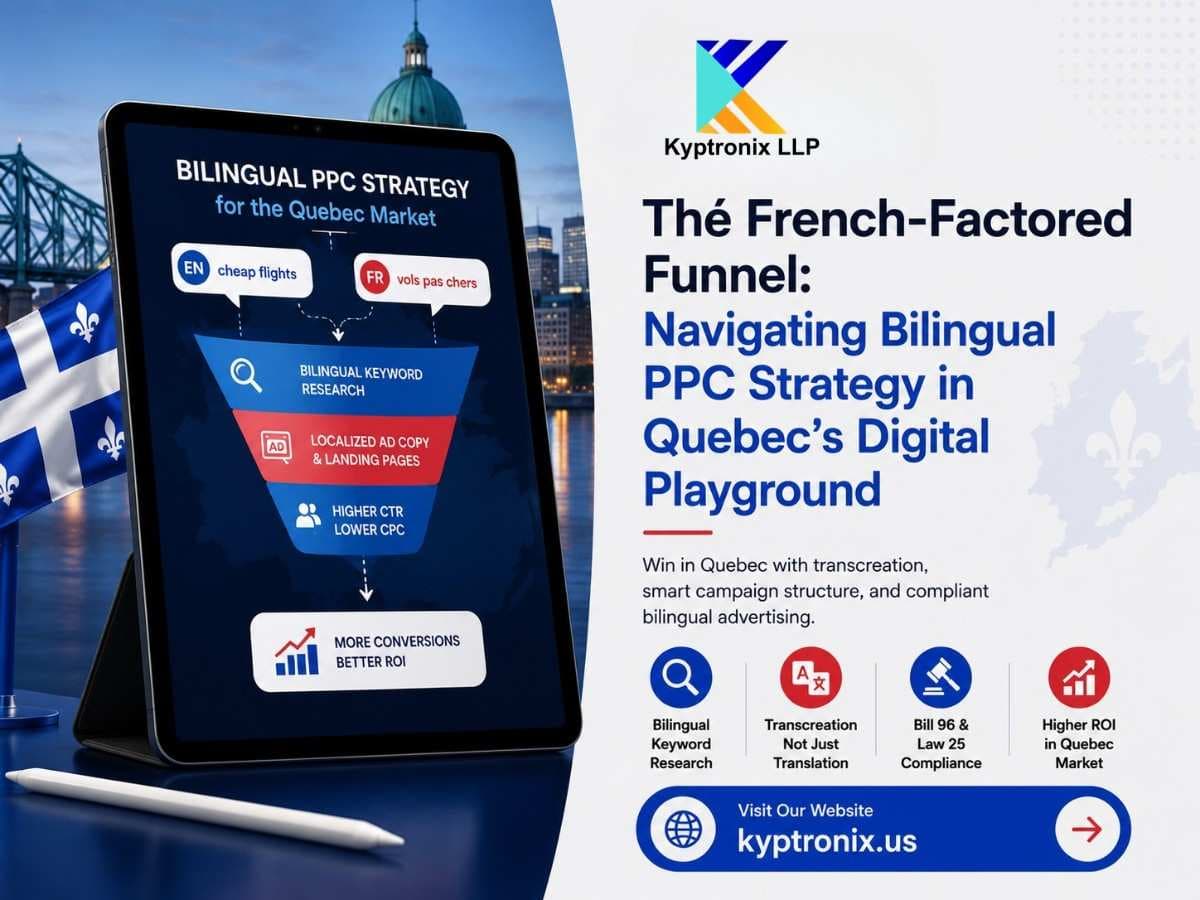
Montreal is one of the most vibrant, economically diverse, and culturally unique metropolitan areas in North America. As Canada's second-largest city, it serves as a bustling hub for artificial intelligence, interactive media, aerospace, and global commerce. But for digital marketers, Montreal presents a fascinating paradox. It is a highly sophisticated, dual-language market where traditional, cookie-cutter search campaigns go to die.
If you are a business looking to capture market share in Quebec, you cannot simply take your high-performing English campaigns, run them through a basic translation tool, and press "launch." This copy-paste approach is one of the fastest ways to burn through your marketing capital while alienating the exact audience you want to reach.
Winning in Quebec requires a deep, structural understanding of bilingual search behavior, localized psychological triggers, and strict provincial regulations. Partnering with an expert PPC Agency Montreal provides the localized precision, regulatory compliance, and analytical execution needed to turn Quebec’s linguistic nuances into your ultimate digital competitive advantage.
Beyond Translation: The Art of Transcreation in Bilingual Search
The foundational mistake most foreign agencies make when targeting the Quebec market is treating translation as a purely mechanical task. In the world of search engine marketing, direct translation is a conversion killer.
Quebec French is a distinct, living language with its own colloquialisms, cultural references, and search habits. To capture high-intent traffic, campaigns must employ transcreation, which means adapting a message from one language to another while maintaining its original intent, tone, context, and emotional trigger.
Consider the common search query for "cheap flights." A direct, literal translation would yield "vols bon marché." While grammatically correct, this is not how local consumers search. A native Montrealer will almost always search for "vols pas chers." If your campaign bids heavily on "vols bon marché," you will completely miss the core search volume.
Furthermore, Montreal's tech and business communities frequently use hybrid terms or "Franglais" in conversational searches. For instance, in professional circles, queries like "bâtir son branding" or "services de marketing digital" are highly common, combining English terminology with French sentence structures.
Deploying bilingual Google Ads Montreal requires continuous keyword discovery led by native linguistic experts who understand these real-world search behaviors. This ensures your ad copy sounds naturally human, bypasses high-competition English auctions, and targets high-converting, low-CPC French search phrases.
The Structural Blueprint: Why You Must Segregate Campaigns by Language
In the quest to save time during account setup, some advertisers attempt to bundle both French and English keywords into a single, multilingual campaign or even the same ad group. This is an absolute structural failure that will quickly ruin your Quality Score and inflate your cost-per-click (CPC).
To maintain peak efficiency, your campaigns must be strictly segregated by language at the campaign level. This structural separation is critical for several technical reasons:
1. Quality Score Integrity
Google calculates your Quality Score based on three core components: expected click-through rate (CTR), ad relevance, and landing page experience. If an English-speaking user triggers a French ad because of pooled keywords, they will not click, or they will bounce immediately. This drops your CTR and ad relevance, tanking your Quality Score and forcing you to pay up to 400% more per click to maintain your ad position.
2. Landing Page Alignment
A seamless user experience requires absolute continuity. If a user clicks on a French search ad, they must land on a fully localized, French-language landing page. Bundling languages makes it incredibly difficult to route users dynamically to the correct URL, resulting in broken user journeys and abandoned shopping carts.
3. Budget Control and Bid Management
French and English auctions in Quebec have vastly different competitive dynamics. Often, the French search space is less crowded, resulting in lower average CPCs and higher conversion rates. By segregating your campaigns, you can allocate your budget dynamically, funneling more capital into the most profitable language channels based on real-time performance.
Navigating Bill 96 and Law 25: Legal Compliance in Quebec Ad Space
In Quebec, digital marketing is not just a matter of performance optimization. It is also a matter of legal compliance. The introduction of Bill 96 (the Act respecting French, the official and common language of Quebec) has established strict guidelines for commercial communications, customer service, and digital advertising within the province.
Under these mandates, any business advertising or selling products to consumers in Quebec must ensure that the French version of its commercial materials, including digital ads, social media posts, and product landing pages, is of equal prominence and quality to any English version.
Additionally, Law 25 (Quebec’s modernized private-sector privacy legislation) imposes some of the strictest data-privacy frameworks in North America, mirroring Europe's GDPR. It requires explicit, user-friendly opt-in consent for tracking cookies and pixel deployments.
An experienced PPC Agency Montreal must ensure that your campaign infrastructure, from ad copy and tracking pixels to the checkout page, complies fully with both OQLF (Office québécois de la langue française) regulations and Law 25. Failing to meet these legal requirements can lead to heavy corporate fines and severe brand reputation damage in the local market.
The Mathematics of Bilingual Optimization: Factoring Language Weights into ROI
To truly optimize a multilingual budget across Quebec, a performance marketer must look at the mathematical weights of each language's performance metrics. If we assume that the overall performance of your Montreal campaigns is a function of French (FR) and English (EN) traffic, we can calculate the Expected Cost-Per-Click (eCPC) of a bilingual account structure using this weighted conversion cost parity model:
eCPCQuebec = (WFR • CPCFR • CTRFR) + (WEN • CPCEN • CTREN) ➗ (WFR • CTRFR) + (WEN • CTREN)
Where:
WFR and WEN represent the language market weights (e.g., Quebec is roughly 77% native French-speaking, though Montreal has a higher concentration of bilingual and English-dominant consumers).
CPCFR and CPCEN represent the real-time cost-per-click in their respective language auctions.
CTRFR and CTREN represent the expected click-through rates.
Because French auctions in Quebec often experience less competition from US-based generic advertisers, CPC_{FR} is frequently lower than CPC_{EN}. By utilizing these mathematical performance differences, localized Montreal PPC Services can strategically shift budgets to lower your overall blended acquisition costs while scaling your lead volume.
Choosing a True Local Growth Engine: Why Kyptronix US is Your PPC Agency Montreal?
Mastering the complexity of the Quebec digital market requires a rare combination of technical search expertise, deep data analytics, and authentic local cultural alignment. Relying on automated bidding tools or a single-language marketing team will inevitably limit your growth in Canada's most unique economic region.
This is where Kyptronix US makes the difference. As an elite, data-driven PPC Agency Montreal, Kyptronix US bridges the gap between sophisticated search engine technology and hyper-localized consumer psychology.
The specialist team at Kyptronix US doesn't just translate keywords. We transcreate entire campaigns. By engineering segregated bilingual ad groups, implementing compliance-first tracking networks under Law 25, and utilizing advanced optimization formulas, we turn search queries into highly profitable local revenue. Whether your goal is to capture high-value commercial contracts in downtown Montreal or scale consumer sales across the province of Quebec, Kyptronix US provides the data-backed execution needed to ensure your ad spend yields maximum impact.
Ready to dominate Quebec’s bilingual market? Discover how the expert performance engineers at Kyptronix US can transform your paid search presence into an active growth driver today.
Frequently Asked Questions (FAQs)
1. Why does my business need a specialized PPC Agency Montreal?
A specialized agency possesses the cultural, linguistic, and regulatory expertise necessary to navigate the unique Quebec marketplace. They ensure your campaigns connect with local consumers, lower your acquisition costs through targeted French keyword auctions, and protect your brand from costly local compliance violations.
2. What is "transcreation" in the context of Google Ads?
Transcreation is the practice of capturing the emotional trigger, intent, and tone of an ad copy in one language and completely rebuilding it in another, rather than translating it literally. This ensures your ads sound natural, authentic, and culturally relevant to native French speakers.
3. How do Quebec's language laws (Bill 96) affect my digital ads?
Under Bill 96, commercial operations targeting consumers in Quebec must provide French communications of equal quality and prominence. This means your search ads, social media copy, and product landing pages must have high-quality, native French versions.
4. Why shouldn’t I run bilingual keywords in the same ad group?
Grouping French and English keywords together confuses search engine algorithms, hurts your ad relevance, and lowers your Quality Score. This poor setup leads to inflated CPCs, incorrect landing page routing, and wasted ad spend.
5. What is Law 25, and how does it impact PPC tracking in Quebec?
Law 25 is Quebec's modernized data privacy law, similar to Europe's GDPR. It requires digital advertisers to obtain clear, active consent from users before deploying tracking cookies, pixels, or analytical tag networks.
6. Are Google Ads in French cheaper than in English in Canada?
Yes, French search auctions in Canada often have less competition from international brands, which generally results in lower cost-per-click (CPC) rates and a higher overall return on ad spend (ROAS).
7. What are the key elements of professional Montreal PPC Services?
Professional Montreal PPC Services provide comprehensive bilingual keyword transcreation, separate French and English campaign structures, local regulatory compliance integration (Bill 96 and Law 25), continuous conversion rate optimization, and transparent performance reporting.
8. How do you optimize PPC campaigns for a bilingual audience in Montreal?
By strictly separating English and French keywords into dedicated campaigns, routing users to identical French/English landing pages, and continuously adjusting geo-targeted bids based on localized postal code data.
9. What is the average timeline to see results from a professional PPC campaign?
While PPC ads can drive traffic almost immediately, optimizing a campaign to its peak conversion efficiency typically takes 30 to 90 days as the system gathers and analyzes local audience and search data.
10. Does Kyptronix US manage cross-border PPC campaigns?
Yes, Kyptronix US specializes in scaling brands globally and regionally, building custom, localized PPC search networks that perform seamlessly across both the Canadian and United States markets.