Think about the last time your enterprise initiated a high-value cross-border transaction, updated a complex supply chain ledger, or audited a multi-party compliance record. How many layers of intermediaries, manual verifications, and redundant security protocols did it take to establish absolute certainty? In a hyper-connected global economy, trust has ironically become our heaviest corporate tax.
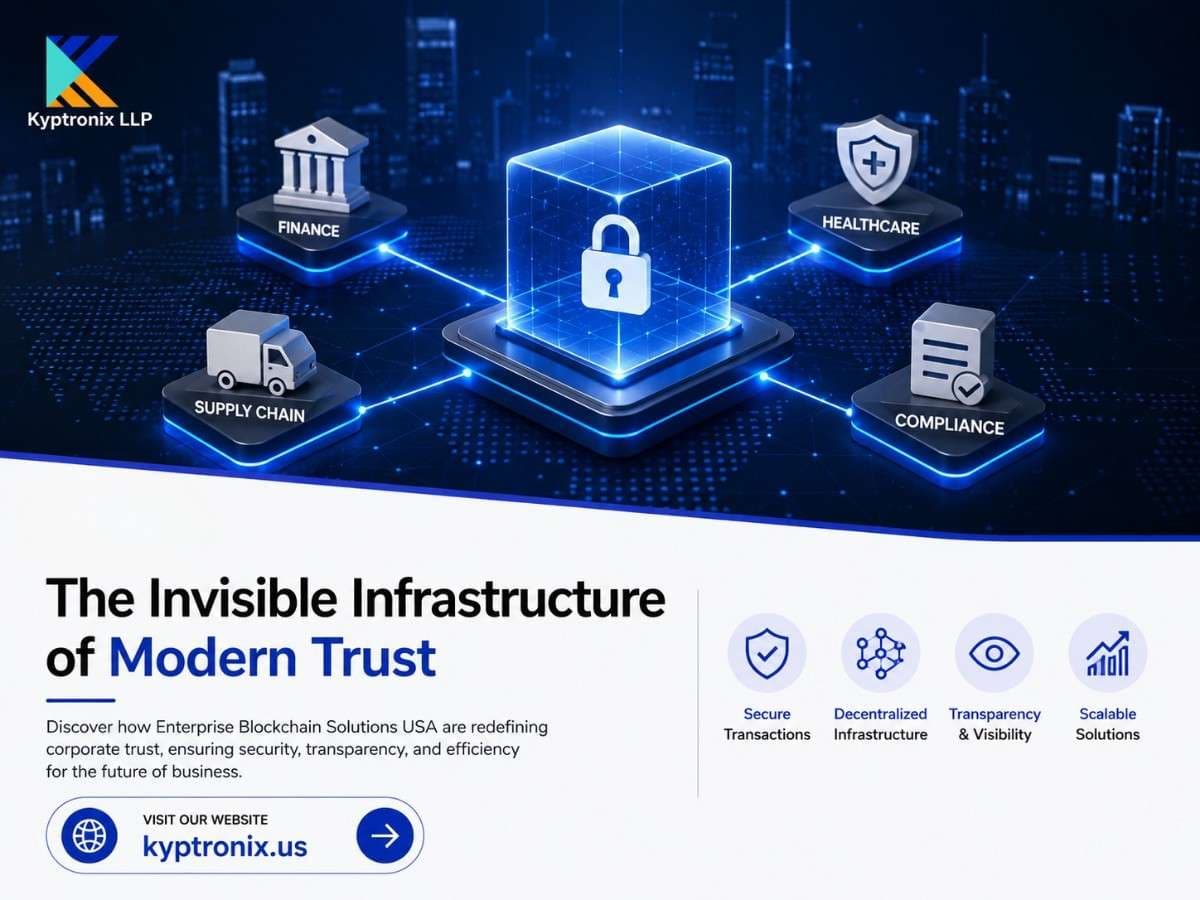
For American businesses operating in high-stakes sectors like finance, healthcare, and logistics, relying on centralized legacy databases is no longer just an operational bottleneck. It is a security vulnerability. This is precisely why forward-thinking C-suite executives and IT architects are shifting their attention towards robust Enterprise Blockchain Solutions USA.
Blockchain has matured far beyond the speculative noise of cryptocurrency. In 2026, it stands as a sophisticated paradigm of deep-tech engineering designed to solve a fundamental corporate dilemma: How do you build flawless, unalterable trust between distinct entities without sacrificing data privacy or operational speed? Let’s pull back the curtain on the architectural patterns, security paradigms, and strategic frameworks that make enterprise-grade decentralized infrastructure the ultimate competitive edge for US businesses.
The Evolution of Trust: Moving Beyond Legacy Centralization
To understand why a leading Blockchain Development Company in USA is flooded with enterprise inquiries today, we must examine the architectural failures of the traditional corporate tech stack.
For decades, enterprises relied on relational databases (SQL) or cloud-hosted centralized data lakes. While these systems are incredibly fast, they operate on an implicit "silo" model. Every company maintains its own version of the truth. When these companies interact, they spend millions of dollars on reconciliation processes, manually matching invoices, tracking shipments, and verifying identities.
Enterprise Blockchain Solutions USA replaces this fragmented ecosystem with a shared, immutable ledger. Instead of trusting a single third-party intermediary or hoping that a partner’s database hasn't been compromised, enterprises place their trust in mathematics, cryptographic consensus, and distributed governance. This shift slashes operational friction, mitigates fraud risks, and establishes a definitive, single source of truth across complex corporate ecosystems.
Decoding the Enterprise Blockchain Architecture: Permissioned vs. Hybrid Models
Unlike public networks like Bitcoin or Ethereum, where anyone can join, view transactions, and validate blocks, enterprises require strict control over data visibility and participant identity. This is where a highly specialized Enterprise Blockchain Architecture comes into play.
Modern corporate deployments typically leverage one of two architectural frameworks:
1. Private and Permissioned Networks
In a permissioned blockchain, participation is invite-only. A consortium of trusted partners manages the network's validating nodes. This model is ideal for highly regulated environments where data sovereignty is paramount.
Hyperledger Fabric: Developed by the Linux Foundation, Fabric utilizes a modular architecture where components like consensus and membership services can be seamlessly plugged in. It supports "channels," allowing private transactions between specific network members without broadcasting data to the entire consortium.
R3 Corda: Designed specifically for regulated financial institutions, Corda isn't strictly a blockchain but a distributed ledger. It ensures that data is shared only on a "need-to-know" basis, drastically optimizing privacy and performance.
ConsenSys Quorum: An enterprise-focused version of Ethereum, Quorum allows for both public and private smart contract execution, perfectly blending enterprise control with open-source innovation.
2. Hybrid Architectures and Layer-2 Scaling
The latest trend across the US tech landscape involves hybrid systems. Enterprises utilize private networks for internal operations and data processing, while anchoring cryptographic proofs (state roots) onto public Layer-1 or Layer-2 blockchains, like Ethereum rollups. This approach delivers the absolute privacy of an enterprise silo combined with the unalterable security of a global public network.
The Deep-Tech Pillars: Privacy, Scalability, and Interoperability
Building an Enterprise Blockchain Architecture that can handle the rigorous demands of a Fortune 500 company requires a deep dive into advanced cryptographic and structural concepts.
Zero-Knowledge Proofs (ZKPs): Absolute Privacy
One of the historical hurdles for enterprise adoption was confidentiality. How do you validate a transaction on a shared ledger without revealing proprietary data, pricing models, or patient identities? The answer lies in Zero-Knowledge Proofs (ZKPs). ZKPs allow one party to mathematically prove to another that a statement is true without revealing any information beyond the statement's validity. For instance, a pharmaceutical supplier can prove they possess a valid FDA certification without revealing sensitive corporate data.
High-Performance Consensus Mechanisms
Public blockchains often sacrifice speed for radical decentralization. Enterprises cannot afford to wait minutes for a transaction to clear. Enterprise networks deploy high-throughput consensus models like Proof of Authority (PoA) or Raft Consensus. These algorithms allow systems to achieve thousands of transactions per second (TPS) with near-instant finality, meeting the performance benchmarks of traditional enterprise software.
Seamless Enterprise System Integration
A blockchain cannot exist in a vacuum. To deliver true value, it must integrate flawlessly with existing legacy infrastructures, such as Enterprise Resource Planning (ERP) tools like SAP and Oracle, Customer Relationship Management (CRM) platforms, and real-time IoT sensors. Modern Enterprise Blockchain Solutions USA leverage robust API gateways and advanced middleware to turn blockchain into an active, real-time extension of an organization’s existing software environment.
Transforming American Industries: Real-World Impacts
According to research by the Boston Consulting Group (BCG), the tokenization of global illiquid and real-world assets (RWAs) is projected to scale into a multi-trillion-dollar market by the end of the decade. This monumental shift is already happening across core US industries.
1. Next-Gen Supply Chain Resilience
In the wake of global disruptions, US logistics firms are using distributed ledgers to map supply chains end-to-end. By combining IoT sensors with blockchain, companies track temperature-sensitive pharmaceuticals or perishable foods from the manufacturing plant directly to the retailer. Every temperature fluctuation, transit delay, and custody transfer is immutably recorded, radically minimizing waste and simplifying regulatory compliance.
2. Institutional Finance and Asset Tokenization
Wall Street is undergoing a quiet, structural revolution. Major US banking institutions are deploying private ledgers to tokenize traditional financial assets, including real estate, bonds, and private equity. Tokenization fractionalizes these assets, injects unprecedented liquidity into previously stagnant markets, and automates complex compliance rules (like KYC/AML) natively within the asset's underlying smart contract code.
3. Healthcare Data Interoperability
Patient data fragmentation is a massive operational friction point in the US healthcare system. Blockchain frameworks enable secure, unified medical data sharing across disparate hospital networks, insurance providers, and pharmacies. Patients maintain sovereign control over their records, granting temporary, fully auditable access to decryption keys to authorized healthcare practitioners.
Overcoming the Execution Hurdles: The Path to Successful Deployment
Transitioning from a legacy database environment to an enterprise blockchain framework requires a rigorous, strategic blueprint. Enterprises frequently stumble when they attempt to treat a decentralized project exactly like a traditional IT roll-out. Success hinges on navigating three foundational phases:
Defining the Consortium Governance: If multiple companies share a ledger, who defines the rules? Establishing a clear governance framework—outlining node responsibilities, cost-sharing models, and data standards—is vital before writing a single line of code.
Mitigating Smart Contract Risks: Smart contracts automate processes natively, but code vulnerabilities can lead to catastrophic exploits. Partnering with an expert Blockchain Development Company in USA ensures that your system undergoes exhaustive cryptographic audits, penetration testing, and formal verification.
Ensuring Regulatory Compliance: Navigating the shifting legal landscape of US data regulations, such as CCPA, HIPAA, and federal financial mandates, is essential. The chosen architecture must be carefully engineered to respect data erasure requests, i.e., "the right to be forgotten," while maintaining immutable ledger integrity.
Conclusion: Engineering Tomorrow’s Trust with Kyptronix US
The corporate landscape is dividing into two distinct factions: businesses bogged down by the frictional costs of manual reconciliation, and agile enterprises moving at the speed of cryptographic certainty. Implementing enterprise-grade decentralized ledgers is no longer an experimental R&D initiative. It is a foundational imperative for maintaining market leadership.
Building these systems requires deep structural expertise, specialized cryptographic knowledge, and an intimate understanding of enterprise workflows. This is where Kyptronix US shines. As a premier Blockchain Development Company in USA, Kyptronix US specializes in designing, auditing, and scaling custom Enterprise Blockchain Solutions USA tailored precisely to your operational needs. Whether you are aiming to transform supply chain visibility, pioneer real-world asset tokenization, or engineer a highly resilient, private Enterprise Blockchain Architecture, the dedicated engineering team at Kyptronix US bridges the gap between deep-tech innovation and dependable corporate execution.
Ready to transform your enterprise infrastructure into an unshakeable ecosystem of trust? Connect with the technology experts at Kyptronix US today, and let's co-engineer the future of your industry.
Frequently Asked Questions (FAQs)
1. What exactly are Enterprise Blockchain Solutions USA?
They are secure, permissioned, or hybrid distributed ledger infrastructures tailored specifically for corporate use cases in the United States. These solutions optimize business operations, guarantee data immutability, automate compliance, and eliminate expensive middle-tier verification across B2B networks.
2. How does an enterprise blockchain differ from a public network like Bitcoin?
Public networks are entirely anonymous, open to anyone, and can exhibit slower transaction times. Conversely, enterprise blockchains are permissioned networks where participant identities are fully verified, access rights are strictly managed, and performance is optimized for high-throughput corporate processing.
3. Can an enterprise blockchain comply with privacy regulations like HIPAA and CCPA?
Yes. By deploying an advanced Enterprise Blockchain Architecture utilizing Zero-Knowledge Proofs (ZKPs) and off-chain data storage models, enterprises can securely validate transactions and store sensitive metadata without exposing regulated Personal Identifiable Information (PII) on the ledger.
4. What are the most common frameworks used for corporate blockchain architecture?
The most reliable and widely deployed corporate frameworks include Hyperledger Fabric (modular and highly customizable), R3 Corda (optimized for regulated banking and finance), and ConsenSys Quorum (an enterprise-focused iteration of Ethereum).
5. Why should a business work with a dedicated Blockchain Development Company in USA?
US-based development partners like Kyptronix US provide localized domain expertise, a thorough understanding of domestic regulatory landscapes, such as SEC, FINRA, and HIPAA mandates, and the deep-tech engineering capability required to securely integrate decentralized networks with legacy enterprise software.
6. What is the role of smart contracts in corporate workflows?
Smart contracts are self-executing lines of code stored directly on the blockchain. They automatically trigger actions, like releasing cross-border vendor payments or updating inventory statuses, immediately when predetermined conditions are met, eliminating manual friction.
7. How fast can an enterprise blockchain process transactions?
Unlike public networks, permissioned corporate blockchains use high-performance consensus algorithms, such as Proof of Authority. This allows them to scale easily to thousands of transactions per second (TPS) with near-instantaneous transaction finality.
8. Is it possible to integrate blockchain with our current SAP or Oracle ERP systems?
Absolutely. Modern decentralized solutions utilize specialized middleware and secure enterprise API gateways to read and write data directly between existing ERP systems, CRMs, and IoT networks without disrupting your everyday workflows.
9. What is Real-World Asset (RWA) tokenization?
RWA tokenization is the process of converting ownership rights of a physical or financial asset, such as real estate, private equity, or commodities, into a digital cryptographic token on a ledger. This increases market liquidity, reduces transactional overhead, and enables fractional ownership.
10. How long does it typically take to deploy a custom enterprise blockchain solution?
Timeline varies based on complexity. A proof-of-concept (PoC) can often be engineered within 6 to 12 weeks, while full-scale production deployment, including thorough security audits and legacy system integrations, generally takes 6 to 12 months.