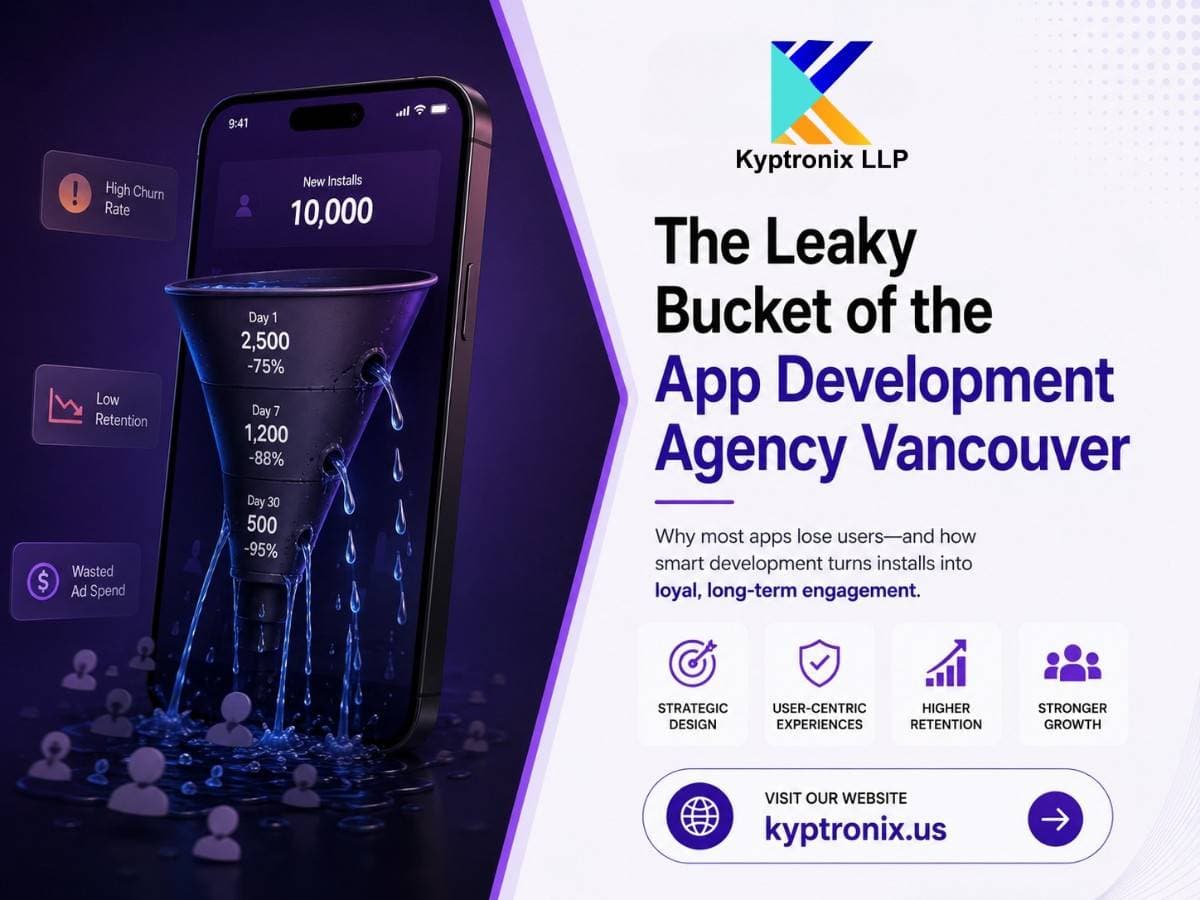
Imagine launching a beautiful, sleek mobile application. Your marketing engine works perfectly, user acquisition costs are stable, and the downloads start pouring in across Canada. But within thirty days, a quiet disaster unfolds: over 90% of those newly acquired users open the app once and never return.
This is the reality of the digital economy. According to cross-industry data, the median Day 30 app retention rate hovers around a mere 5% to 7%. This means that for the vast majority of digital products, acquisition marketing is just filling a leaky bucket.
In a competitive market like British Columbia, which now boasts over 12,000 active technology firms, simply launching an app with clean code is no longer enough to win. To build a highly profitable digital product, your software strategy must shift its focus from simple acquisition to psychological retention. Partnering with an expert App Development Agency Vancouver provides your business with the strategic design required to transform a simple download into a long-term, habit-forming daily routine.
The Architecture of Desire: Applying the Hook Model to Mobile UI/UX
How do products like Duolingo, Strava, or Spotify keep users coming back without relying on aggressive, expensive marketing campaigns? They build habit loops directly into their interface.
When you collaborate with a leading provider of mobile app development Vancouver, the design phase should be centered around behavioral psychology frameworks. One of the most effective methods is the Hook Model, a four-stage process designed to naturally influence user behavior, which is explained below:
1. The Trigger (External vs. Internal)
Every habit loop requires a spark. External triggers are systems like push notifications, localized text alerts, or email reminders. However, over-relying on external triggers can alienate users, leading them to quickly turn off notifications.
The ultimate goal is to transition users toward internal triggers. These are emotional or situational cues that happen organically in a user's mind. For instance, when a user feels a wave of professional clutter, they naturally open a productivity app like Notion. When they finish a run around Vancouver's Stanley Park seawall, they immediately open Strava to log their progress.
2. The Action
The action phase is the simplest behavior a user executes in anticipation of a reward. The foundational rule here is straightforward: minimize friction. If a user must navigate through three loading screens and a complex login form just to log a daily habit, they will abandon the app. High-performance iOS and Android application engineering prioritizes single-tap actions, intuitive biometrics, and clean, streamlined layouts to make engagement effortless.
3. The Variable Reward
Humans are biologically wired to seek predictability, but we are deeply fascinated by the unexpected. Standard, unchanging rewards eventually cause mental fatigue and disinterest. Introducing variable rewards keeps the brain engaged. This can be as simple as a randomized daily achievement badge, an evolving algorithmic content feed, or a surprise streak bonus after completing a multi-day challenge.
4. The Investment
The final phase is where true retention is solidified. The investment phase occurs when the user puts something of value back into the app, such as personal data, custom settings, a loyalty point balance, or a growing streak record. The more time and effort a user invests in tailoring their experience, the higher the psychological switching cost becomes, making it incredibly difficult for them to leave for a competitor.
Removing the Sandpaper: Optimizing Time-to-Value (TTV)
A common mistake made during product development is forcing users to complete a long, multi-step onboarding process before letting them experience the application's actual utility.
The onboarding stage is your highest-leverage retention window. Industry studies demonstrate that apps getting users to a core value action within their very first session experience Day 7 retention rates that are two to three times higher than those that do not.
To optimize Time-to-Value (TTV), your development team must focus on eliminating digital obstacles:
Implement Lazy Registration: Allow users to explore the app’s features and core functionality before requiring them to create an account or link a credit card.
Use Progressive Disclosure: Avoid overwhelming a new user with all your complex features at once. Introduce advanced tools gradually as the user becomes more comfortable with the primary dashboard.
Design Humanized Micro-Interactions: Use clear progress bars, minimal inline text, and seamless transitions to make the initial experience feel satisfying and productive.
Gauging the Economics of Retention
To see how improving your retention rate directly shifts your business metrics, use the interactive calculator below. Adjust your acquisition costs and retention rates to see how a sticky user experience transforms your customer lifetime value (LTV).
Local Alignment: Designing Software for Vancouver's Diverse Tech Hub
Vancouver’s tech sector is recognized globally for its focus on sustainability, digital health, interactive entertainment, and consumer-focused marketplaces. Major foundational events like Web Summit Vancouver 2026 bring a highly discerning, tech-literate audience to the city's digital doorstep.
When launching a product in Canada, local engineering decisions must reflect real-world user infrastructure:
Flawless Offline Modes: Vancouverites are highly active and frequently move through transit dead zones, whether commuting on the SkyTrain or hiking up the North Shore mountains. Your software must cache data smoothly and offer robust offline functionality to prevent frustrating crashes when connectivity drops.
Strictest Privacy Norms: Canadian users place an exceptionally high value on data control. Your application must be fully engineered to comply with federal PIPEDA regulations and British Columbia’s PIPA frameworks, offering transparent, easily accessible privacy controls natively in the app interface.
Choosing the Right Path: Custom Scaling vs. Fast Templates
When looking to scale an idea, businesses often face a choice: build a fast, template-based hybrid app or invest in a custom-tailored native framework. While templates might save time initially, they often limit your long-term scalability.
Building a habit-forming user experience requires custom animations, highly responsive feedback loops, and deeply personalized data architectures. Partnering with a premier App Development Company Vancouver ensures your underlying tech stack is perfectly optimized for performance, scalability, and long-term user retention.
Conclusion: Build an App That Users Cannot Live Without
The true measure of an application's market value isn't found in your initial download metrics. It is proven by your active daily user loops. In a digital environment where attention is scarce, building a product that naturally forms lasting user habits is your ultimate competitive advantage.
Achieving this level of engagement requires a deep understanding of cloud engineering, advanced data analytics, and user psychology. This is where Kyptronix US steps in. As an authoritative App Development Agency Vancouver, Kyptronix US combines high-performance system engineering with behavioral design principles to build sticky, intuitive, and highly scalable digital products. Whether your goal is to optimize an enterprise product's onboarding flow or launch a completely new consumer platform across Canada, the development team at Kyptronix US provides the technical expertise to turn your vision into an indispensable daily tool.
Ready to stop filling a leaky bucket and build an application that scales? Contact the performance-driven product engineering team at Kyptronix US today, and let's build the future of your industry together.
Frequently Asked Questions (FAQs)
1. What does an App Development Agency Vancouver do?
A specialized App Development Agency Vancouver manages the entire lifecycle of a mobile or web application, from initial market discovery, wireframing, and behavioral UI/UX design to native platform coding, rigorous security testing, and long-term product scaling.
2. Why is user retention more important than app downloads?
Downloads only represent initial interest, which can result in wasted acquisition capital if users quickly leave. User retention measures your app’s actual product-market fit, long-term health, and ability to generate consistent recurring revenue over time.
3. What is the "Hook Model" in app design?
Developed by behavioral expert Nir Eyal, the Hook Model is a design framework consisting of four parts: Trigger, Action, Variable Reward, and Investment. It is used to create natural user loops that encourage regular, unprompted engagement.
4. How can we improve our app's onboarding experience?
You can optimize the onboarding process by shortening the time-to-value (TTV), allowing users to explore features before registration, and using progressive disclosure to introduce advanced settings smoothly without overwhelming them.
5. What are the key indicators of a sticky app?
The most reliable stickiness metrics are your Daily Active Users to Monthly Active Users ratio (DAU/MAU stickiness ratio), Day 1, Day 7, and Day 30 retention rates, average session duration, and your user churn rate.
6. How do Canadian privacy laws like PIPEDA affect mobile app development?
PIPEDA and BC's PIPA laws require apps to obtain clear user consent before collecting data, limit data collection to necessary features, provide clear privacy policies, and use advanced encryption to safeguard sensitive user information.
7. What is the average cost of working with a premier App Development Company Vancouver?
The overall investment varies depending on your app's complexity, integration requirements, and feature set. A foundational MVP (Minimum Viable Product) typically scales from 40,000 to $80,000, while complex enterprise platforms require larger custom budgets.
8. Should I build a native app or a cross-platform solution?
Native apps (built using Swift or Kotlin) offer maximum performance and fluid animations, making them ideal for high-interaction or gaming apps. Cross-platform frameworks, like Flutter or React Native, allow you to deploy on both iOS and Android simultaneously from a single codebase, reducing initial development time.
9. How do push notifications impact user retention?
When personalization is precise, push notifications serve as excellent external triggers that boost engagement. However, sending generic, high-frequency alerts can frustrate users, leading them to turn off notifications or uninstall the app completely.
10. How long does it take to develop a custom mobile app from scratch?
A standard production timeline generally ranges from 3 to 6 months. This includes thorough discovery workshops, UX prototyping, agile sprint development, deep platform quality assurance, and deployment to the Apple App Store and Google Play Store.