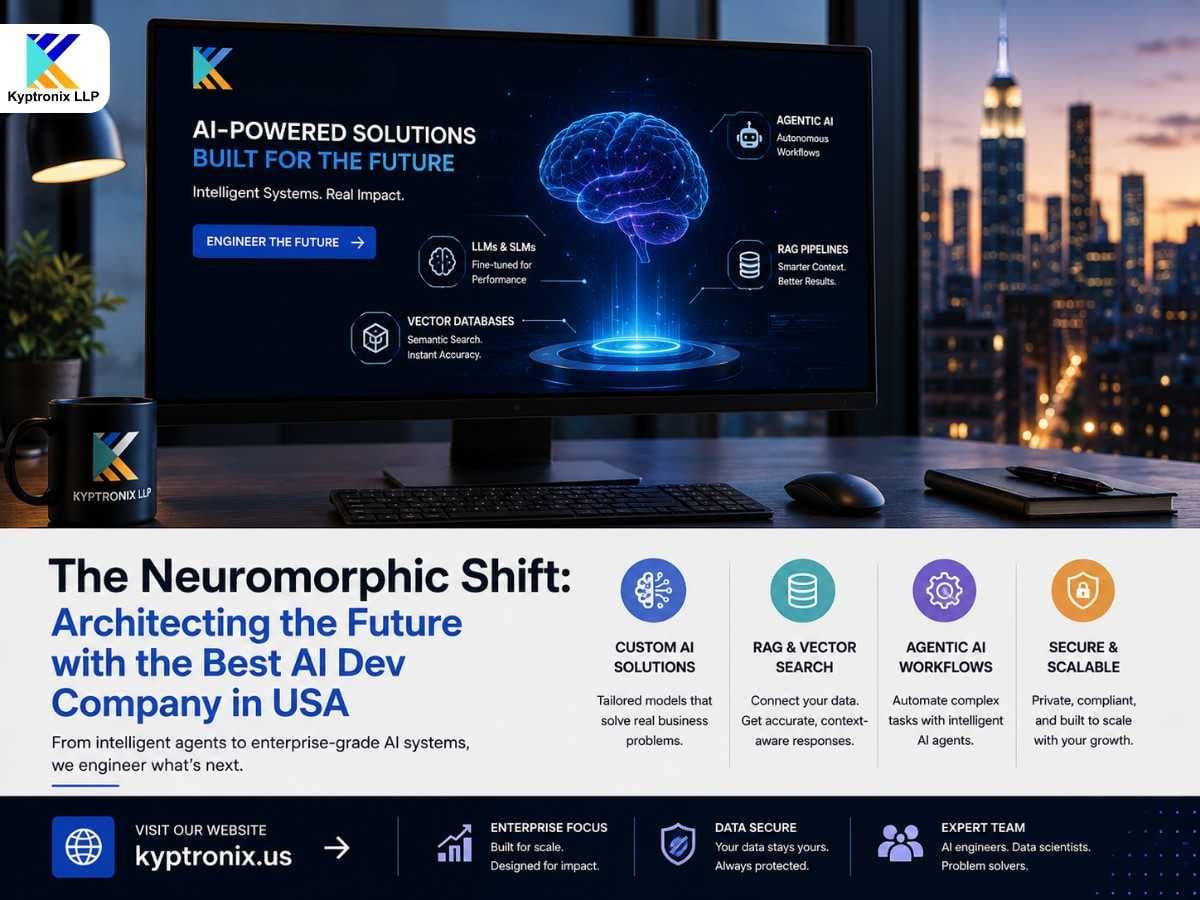
The corporate landscape in the United States is undergoing a quiet, structural transformation. We have moved decisively past the initial wave of artificial intelligence hype. The era of playing around with basic generative chat interfaces and simple API wrappers is over. In 2026, forward-thinking enterprise leaders are asking much harder, highly technical questions, for instance, how do we build secure, self-orchestrating agentic workflows? How do we fine-tune open-source models on proprietary hardware? How do we eliminate mathematical hallucinations in automated decision-making engines?
For American companies operating in high-volume, highly regulated sectors like fintech, healthcare, and advanced supply logistics, the answer lies in building bespoke cognitive systems. Succeeding in this highly technical environment requires more than generic software development. It demands partnering with the Best AI Dev Company in USA to transform complex mathematical models into production-ready digital assets.
Demystifying the Intelligence Stack: Core AI Technologies Exploded
To build a corporate tech stack that actually drives growth, we must look beyond marketing terms and understand the core technologies that power modern machine intelligence. The baseline of modern enterprise artificial intelligence rests on three technical pillars:
1. Large Language Models (LLMs) and Small Language Models (SLMs)
While frontier models, like GPT-4o or Claude 3.5 Sonnet, are excellent for broad, multi-turn reasoning, they are incredibly expensive to run at scale and present serious data privacy risks for sensitive information. Today's enterprises are increasingly deploying highly optimized Small Language Models (SLMs) like Llama 3.1 or Mistral. When custom-built and deployed within private environments, these lighter models match the performance of closed-source giants on specific enterprise tasks at a fraction of the computational cost.
2. Retrieval-Augmented Generation (RAG)
An LLM is only as good as the context it can access. RAG architectures connect your foundation model directly to your secure, internal corporate knowledge base, such as PDFs, SQL databases, and legacy CRMs.
When a user submits a query, the system converts the text into a dense vector embedding. It then runs a similarity search against a high-performance vector database, like Pinecone, Milvus, or Qdrant, to pull only the most relevant chunks of data. This context is then fed into the model alongside the original prompt to generate a highly accurate, citation-backed response.
To evaluate the mathematical efficiency of these semantic database searches, developers measure the similarity of high-dimensional vectors. The standard metric used to calculate this semantic alignment is Cosine Similarity, which is calculated using the following formula:
Cosine Similarity (A, B) = A • B ➗ ║ A ║ ║ B ║ = ∑ni =1 Ai Bi ➗ √∑ni =1 Ai2 √∑ni =1 Bi2
Where:
A and B represent the multi-dimensional vector embeddings of the user query and the database document chunk.
Ai and Bi are the individual components of those vectors.
3. Agentic AI Workflows
The next big step in AI evolution is the shift from passive text generation to active, autonomous agency. Agentic AI systems don't just answer questions. They actively plan, execute multi-step workflows, call external APIs, self-correct their code, and collaborate with other specialized AI agents to solve complex business problems.
Implementing these advanced systems requires specialized engineering expertise. Partnering with a team that provides elite AI Software Development Services USA ensures that your system’s underlying data pipelines are fast, secure, and built to scale.
The Customization Imperative: Beyond Out-of-the-Box APIs
A common mistake made by early-stage technology teams is relying entirely on third-party API integrations. While an out-of-the-box API is fine for building a fast prototype, relying on it for core business operations is a major strategic risk.
When your company's core value proposition relies on a generic third-party API, you have no control over model latency, pricing spikes, or sudden updates that can break your application overnight. Furthermore, sending proprietary client data across public networks can quickly violate strict privacy compliance frameworks.
To build a sustainable, long-term competitive advantage, you must invest in Custom Machine Learning Solutions.
True customization typically follows a rigorous engineering pipeline, as explained below:
Parameter-Efficient Fine-Tuning (PEFT) and LoRA
Instead of spending millions of dollars training a model from scratch, engineers use Low-Rank Adaptation (LoRA) to adapt existing open-source foundation models. LoRA works by keeping the original, massive model weights frozen and training a much smaller set of specialized adapter layers. This allows you to inject deep, domain-specific terminology and custom workflows into the model without needing massive supercomputing clusters.
Custom Loss Function Optimization
During training, the model's parameters are iteratively updated to minimize error. In custom environments, engineers customize the mathematical loss functions to prioritize specific business outcomes, such as minimizing false positives in compliance workflows. The optimization path is governed by minimizing the total regularized loss ($L$), represented by this objective function:
L(𝛳) = 1 ➗ N ∑ Ni=1 ℒ(yi, f(xi; 𝛳) + λ Ω(𝛳)
Where:
𝛳 represents the trainable parameters (weights) of your custom neural network.
ℒ is the loss function evaluating the difference between the true label yi and the model's prediction f(xi; 𝛳).
Ω(𝛳) represents the regularization penalty, such as L1 or L2 regularization, used to prevent overfitting.
λ is the regularization scaling parameter that balances prediction accuracy with model generalization.
By taking control of your AI model's training parameters and data architecture, you protect your company's intellectual property and build a highly defensible market position.
Agentic AI and Autonomous Workflows: The Next Frontier
The true power of enterprise artificial intelligence is unlocked when you move away from simple "prompt-and-response" patterns toward autonomous multi-agent systems.
In a multi-agent system, complex corporate processes are broken down into discrete roles assigned to specialized AI agents. For example, in an automated customer support and billing workflow:
Agent 1 (The Triage Agent): Analyzes incoming customer emails, identifies user sentiment, and routes the ticket to the correct department.
Agent 2 (The Retrieval Specialist): Queries secure internal vector databases to pull relevant user account data and payment histories.
Agent 3 (The Auditor Agent): Cross-references the retrieved customer data against your company's billing policies and payment logs.
Agent 4 (The Draft Writer): Crafts a highly personalized, empathetic, and accurate email response, complete with direct transaction links.
These specialized agents communicate, exchange data, and audit one another's work autonomously in the background, only flagging a human supervisor when they encounter high-risk exceptions.
Building, testing, and deploying these complex multi-agent frameworks requires deep system-level design and engineering. This is why working with the Best AI Dev Company in USA is critical to transforming abstract operational workflows into reliable, revenue-generating automated systems.
Guardrails, Governance, and Security in Enterprise AI
As companies deploy automated models to interact directly with clients and make automated financial or operational decisions, establishing strict security guardrails is a non-negotiable requirement.
US enterprises operate in a complex, shifting regulatory environment. Between the Federal Trade Commission's (FTC) rising focus on algorithmic bias and strict state-level data privacy acts, launching unguided models is a massive legal liability.
To safely scale your digital assets, your system architecture must build in enterprise-grade security protocols from day one:
Active Hallucination Mitigation: Implement real-time consensus filtering and semantic validator layers like NeMo Guardrails to check the model's outputs before they are sent to the user interface.
PII Anonymization Pipelines: Build automated preprocessing layers that automatically detect and scrub sensitive data, such as Social Security Numbers, patient health records, or credit card details, before the prompt is ever sent to an external model.
Comprehensive Audit Logging: Maintain unalterable, structured logs of all model inputs, outputs, vector database queries, and agentic decisions to ensure your systems remain fully auditable and compliant with SOC 2 regulations.
Choosing a True Technological Growth Engine: Kyptronix US
Navigating the complexities of modern machine learning requires a rare balance of deep mathematical expertise, advanced system architecture, and real-world business integration. Relying on pre-built software templates or generic development shops will inevitably cap your company's scalability and compromise your data security.
This is where Kyptronix US makes the difference. As a premier, performance-driven Best AI Dev Company in USA, Kyptronix US bridges the gap between theoretical data science and enterprise-grade software execution.
The engineering team at Kyptronix US specializes in designing, auditing, and scaling custom intelligent solutions. By deploying cutting-edge AI Software Development Services USA and designing bespoke Custom Machine Learning Solutions, we help your business build custom RAG pipelines, deploy autonomous multi-agent systems, and integrate secure models directly into your legacy infrastructure. Whether you are aiming to automate complex transaction processing, optimize logistical supply chains, leverage specialized blockchain solutions, or streamline operations through advanced AI marketing, Kyptronix US provides the technical execution to turn your data into a powerful engine for business growth.
Ready to lead your industry into the era of agentic intelligence? Contact Kyptronix US today to discover how our expert engineers can transform your operational efficiency and build your custom AI future.
Frequently Asked Questions (FAQs)
1. Why does my company need to partner with the Best AI Dev Company in USA?
Partnering with a specialized team ensures your custom models are built securely, integrated seamlessly with your existing IT systems, and optimized for maximum speed and accuracy. This approach prevents expensive development failures and protects your proprietary intellectual property.
2. What are AI Software Development Services USA?
These services encompass the full lifecycle of custom artificial intelligence engineering—including data pipeline preparation, LLM fine-tuning, Retrieval-Augmented Generation (RAG) system building, multi-agent workflow orchestration, and ongoing model monitoring.
3. How do Custom Machine Learning Solutions differ from generic SaaS AI products?
Generic SaaS AI tools are one-size-fits-all platforms built on public APIs that can compromise your data security and limit customization. Custom solutions are built from the ground up for your specific business logic, trained on your private data, and deployed securely in your private cloud.
4. What is Retrieval-Augmented Generation (RAG), and why is it useful?
RAG is an architectural pattern that connects your language model directly to your internal database systems. It allows the model to query your secure, real-time files to retrieve contextually accurate data, drastically reducing hallucinations and eliminating the need for expensive retraining.
5. What are Agentic AI workflows?
Agentic workflows refer to autonomous AI systems designed to plan, execute, and refine multi-step processes on their own. These systems use specialized tools and collaborate with other agents to complete complex operational tasks without needing constant human intervention.
6. How does fine-tuning a model with LoRA save development costs?
Low-Rank Adaptation (LoRA) is a method that keeps a foundation model’s massive base weights frozen while training a much smaller set of specialized parameter layers. This reduces computational requirements, lowering your training costs and accelerating your time-to-market.
7. How can we prevent AI models from hallucinating false information?
Hallucinations can be mitigated by implementing clean RAG data pipelines, setting up strict system prompting parameters, and deploying active semantic validation guards like NeMo Guardrails to audit model outputs before they reach users.
8. Can custom AI models be deployed completely on-premises or in private clouds?
Yes. By utilizing open-source models, such as Llama 3.1 or Mistral, engineers can build and deploy custom systems entirely within your private cloud environment (AWS, Azure, or GCP) or on physical on-premises servers, ensuring absolute data security.
9. What is the role of Vector Databases in enterprise AI?
Vector databases store your unstructured enterprise documents as high-dimensional mathematical representations (embeddings). This allows your AI systems to run lightning-fast similarity searches and retrieve contextually relevant data in milliseconds.
10. How long does a typical custom enterprise AI development project take?
A basic Proof of Concept (PoC) can typically be designed and tested within 8 to 12 weeks, while full production deployment, including deep legacy database integrations and rigorous security compliance audits, generally takes 6 to 12 months.