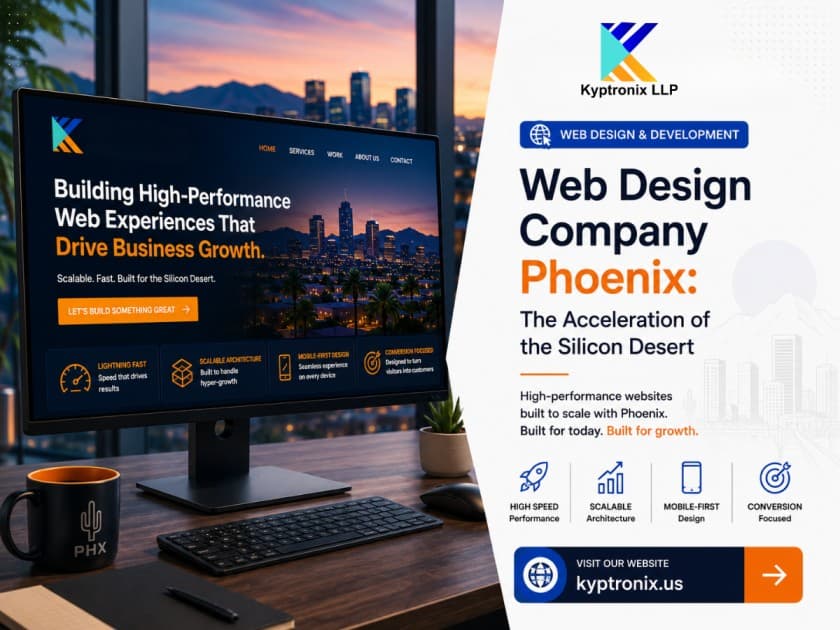
Something extraordinary is happening in the Valley of the Sun. Over the past several years, the Phoenix metropolitan area has shed its reputation as merely a scenic desert retreat to become one of the most explosive technology, manufacturing, and business incubation corridors in North America. Rapidly dubbed the "Silicon Desert," Phoenix has attracted tens of billions of dollars in capital investments, driven by massive expansions in semiconductor fabrication, biotechnology, and clean energy logistics. According to economic growth indicators from the Greater Phoenix Economic Council (GPEC), this regional surge has triggered an unprecedented inflow of venture-backed startups and scaling enterprises.
Yet, as the physical infrastructure of Arizona scales at breakneck speed, a critical digital bottleneck is forming. Many expanding businesses are attempting to capture this booming market using outdated, slow, and structurally rigid web platforms. In a hyper-growth ecosystem, your website is no longer just a passive digital brochure. It is your high-speed operational engine.
To thrive in this competitive climate, partnering with an elite Web Design Company Phoenix is the definitive first step toward transforming your online presence into a high-performance, conversion-driving machine. For businesses operating in fast-moving emerging markets, the goals are clear: absolute scalability and lightning-fast speed.
The Silicon Desert Expansion: Why Scale is the New Default in Phoenix
When a market experiences an economic surge, consumer demand behaves like a flash flood. A sudden feature in a national tech publication, a regional viral marketing campaign, or a major B2B contract acquisition can send web traffic from a few hundred daily visitors to tens of thousands in a matter of minutes.
Traditional, monolithic web builds, often built on legacy, unoptimized content management systems, frequently buckle under the weight of sudden traffic spikes. When your server encounters a database query bottleneck, your page response times skyrocket, leading to a degraded user experience or outright server crashes. In a scaling market, downtime is not just an inconvenience. It represents immediate, lost revenue and permanent brand degradation.
To build for scale, a forward-thinking Web Design Company Phoenix shifts away from rigid database structures toward decoupled, modern architectures. By separating the visual front-end layer from the back-end database (often referred to as headless architecture), your website's static assets can be distributed globally across Edge Server Networks and Content Delivery Networks (CDNs).
When a user in Phoenix or anywhere else in the world accesses your site, they are served pre-rendered static files instantly from the nearest geographic server node, completely bypassing the need to query a central database. This ensures that whether you have 10 or 10,000 concurrent users browsing your services, your platform remains stable, responsive, and secure.
The Millisecond Tax: How Page Load Speed Dictates Digital Profitability
In digital commerce, speed is a tangible currency. As human attention spans continue to compress in the era of instant-answer engines, milliseconds directly dictate your conversion rates.
To visualize this impact, we can take a look at established mathematical models of user behavior. If we assume a page's baseline conversion rate C0 deteriorates exponentially as page load latency ‘t’ increases, we can calculate the conversion loss (△C) using the following formula:
△C = C0 x (1 - e-𝛼Δt)
Where:
△C represents the net loss in overall conversion probability.
C0 is your baseline conversion rate at optimal load speeds.
Δt is the added latency delay in seconds.
𝛼 is the consumer friction coefficient (empirically measured to be exceptionally high in fast-paced commercial markets).
When you invest in professional Phoenix Web Development Services, eliminating this "millisecond tax" is a primary engineering objective. Modern speed optimization requires a systematic approach to code cleanliness by purging unused JavaScript, compressing heavy asset payloads via modern web formats, such as WebP and AVIF, and implementing intelligent resource hinting, such as DNS-prefetching and preloading critical assets. By prioritizing these performance factors, local businesses can slash load times, protect their conversion funnels, and gain a major competitive advantage.
Mobile-First in the Valley: Redefining UX with Responsive Web Design Phoenix
Phoenix is a city defined by movement. From professionals commuting along the Loop 101 to active consumers searching for real-time services on the go, mobile devices dominate local web traffic.
If your digital interface is clumsy, difficult to navigate, or slow to load on a smartphone, you are actively turning away more than half of your potential market. True mobile optimization is far more complex than simply squeezing a desktop website down to fit a smaller screen. It requires a comprehensive approach to Responsive Web Design Phoenix that prioritizes mobile-first layout patterns, touch-friendly navigation targets, and adaptive image scaling.
Furthermore, Google’s search ranking algorithms rely entirely on mobile-first indexing. This means Google evaluates the mobile version of your page's content, structure, and loading speed to determine its position in search results. Working with an agency that prioritizes advanced, responsive design frameworks ensures your platform delivers a flawless, high-performance experience across every device type, including desktops, tablets, and mobile screens.
Under the Hood: Technical Architecture and Phoenix Web Development Services
To build a website that can scale seamlessly, you must select the right underlying technical framework. The modern web development ecosystem offers highly specialized toolkits designed to prioritize both speed and scalability:
Next.js & React Ecosystems: These frameworks utilize Server-Side Rendering (SSR) and Incremental Static Regeneration (ISR) to pre-render pages. This delivers lightning-fast initial load times while allowing dynamic, real-time data updates without full-page reloads.
Tailwind CSS Integration: Replacing bulky, traditional CSS libraries with utility-first styling ensures that your site’s styling files remain incredibly small, clean, and fast to download.
Headless CMS Engines: Utilizing decoupled platforms like Strapi, Sanity, or Contentful allows your content editors to easily manage updates, while your development team preserves the absolute performance of a custom-built, static front-end.
Deploying these advanced systems requires specialized, deep-tech engineering expertise. Investing in enterprise-grade Phoenix Web Development Services ensures that your brand’s underlying code architecture is clean, modern, fully auditable, and built to scale effortlessly for years to come.
Designing for Generative AI: Meeting GEO and AEO Requirements Head-On
The search landscape is undergoing a massive evolution. Users are rapidly moving away from typing simple, disconnected keywords into traditional search bars. Instead, they are engaging directly with conversational AI models and local voice search assistants, asking highly contextual questions.
To remain visible in this next-gen ecosystem, your digital presence must be optimized for Answer Engine Optimization (AEO) and Generative Engine Optimization (GEO). AI systems crawl the web looking for highly authoritative, structured, and easily digestible answers to satisfy user prompts.
To ensure your brand is cited as a trusted source by AI search engines, your website’s design and content structure must adopt modern semantic standards:
Impeccable Semantic HTML: Utilize clean tag structures (<article>, <section>, <header>, <footer>) to help automated crawlers easily interpret the thematic hierarchy of your pages.
Structured Schema Markup: Embed comprehensive JSON-LD schema data directly into your code. This explicitly defines your business's services, physical location, reviews, and industry authority to search crawlers.
Conversational FAQ Modules: Integrate dedicated, direct-answer FAQ sections on your service pages. This naturally aligns your content with the exact conversational phrasing used in generative search prompts.
Choosing a Digital Partner to Navigate the Digital Frontier
In a rapidly expanding market, the quality of your digital infrastructure directly impacts your bottom line. Partnering with a generic agency that relies on bloated, pre-built templates will ultimately limit your site’s performance, search rankings, and scalability.
This is where Kyptronix US makes the difference. As an authoritative, performance-driven Web Design Company Phoenix, Kyptronix US bridges the gap between creative visual design and elite, deep-tech system architecture. The engineering team at Kyptronix US specializes in designing lightning-fast, highly scalable web solutions powered by advanced custom frameworks, Responsive Web Design Phoenix, and modern SEO strategies. Whether your goal is to dominate the regional Southwest market, optimize for conversational search engines, or scale your operations globally, Kyptronix US provides the technical execution required to ensure your web presence remains an active driver of business growth.
Ready to unlock exceptional digital speed and scale? Explore how the expert engineers at Kyptronix US can transform your web platform into a high-performance business asset today.
Frequently Asked Questions (FAQs)
1. Why does my Phoenix business need a custom web build over a standard template?
Standard templates are often bogged down by generic, bloated code, slow loading times, and limited design flexibility. A custom-built website is engineered from the ground up for speed, search visibility, and the precise scalability your business needs to grow.
2. What exactly is a headless CMS, and how does it help my business scale?
A headless CMS separates your website’s content management system from its front-end design layer. This allows your content to be delivered as static files instantly across a global network of servers, protecting your site from crashing during sudden traffic spikes.
3. How does page load speed affect our Google search rankings?
Google uses page load speed and user interaction metrics (Core Web Vitals) as direct search ranking factors. Slower sites provide a poor user experience, leading to higher bounce rates and lower visibility in search results.
4. What is Responsive Web Design Phoenix, and why is it essential?
Responsive Web Design Phoenix is the practice of designing websites that automatically adapt their layouts, images, and navigation menus to fit any screen size. This ensures your site remains fully functional and visually striking across desktops, tablets, and mobile devices.
5. How can we optimize our web design to capture AI search traffic?
To optimize our web design to capture AI search traffic, use clean, semantic HTML code, embed structured schema markup, and design clear, direct-answer FAQ modules that match conversational search patterns.
6. What are the key elements of professional Phoenix Web Development Services?
Professional Phoenix Web Development Services provide custom React or Next.js development, responsive UI/UX design, headless CMS integrations, security hardening, and ongoing performance tuning to keep your site running at peak efficiency.
7. How does an adaptive image strategy improve mobile site performance?
Instead of forcing a mobile device to download a massive desktop-sized image, adaptive image technology automatically resizes and delivers compressed, modern image formats, like WebP, based on the visitor’s screen size.
8. What are Core Web Vitals, and why are they monitored?
Core Web Vitals are a set of real-world user experience metrics defined by Google. They measure how quickly your page loads, how fast it becomes interactive, and how visually stable the layout remains as elements load.
9. Why is Phoenix currently referred to as the "Silicon Desert"?
Phoenix has earned this nickname due to its rapid emergence as a major US technology hub, attracting massive investments in semiconductor fabrication, advanced manufacturing, clean tech, and tech startups.
10. How long does a custom enterprise-grade web design project typically take?
A custom web project generally takes 8 to 16 weeks, depending on design complexity, custom integrations, back-end development requirements, and thorough quality assurance testing.