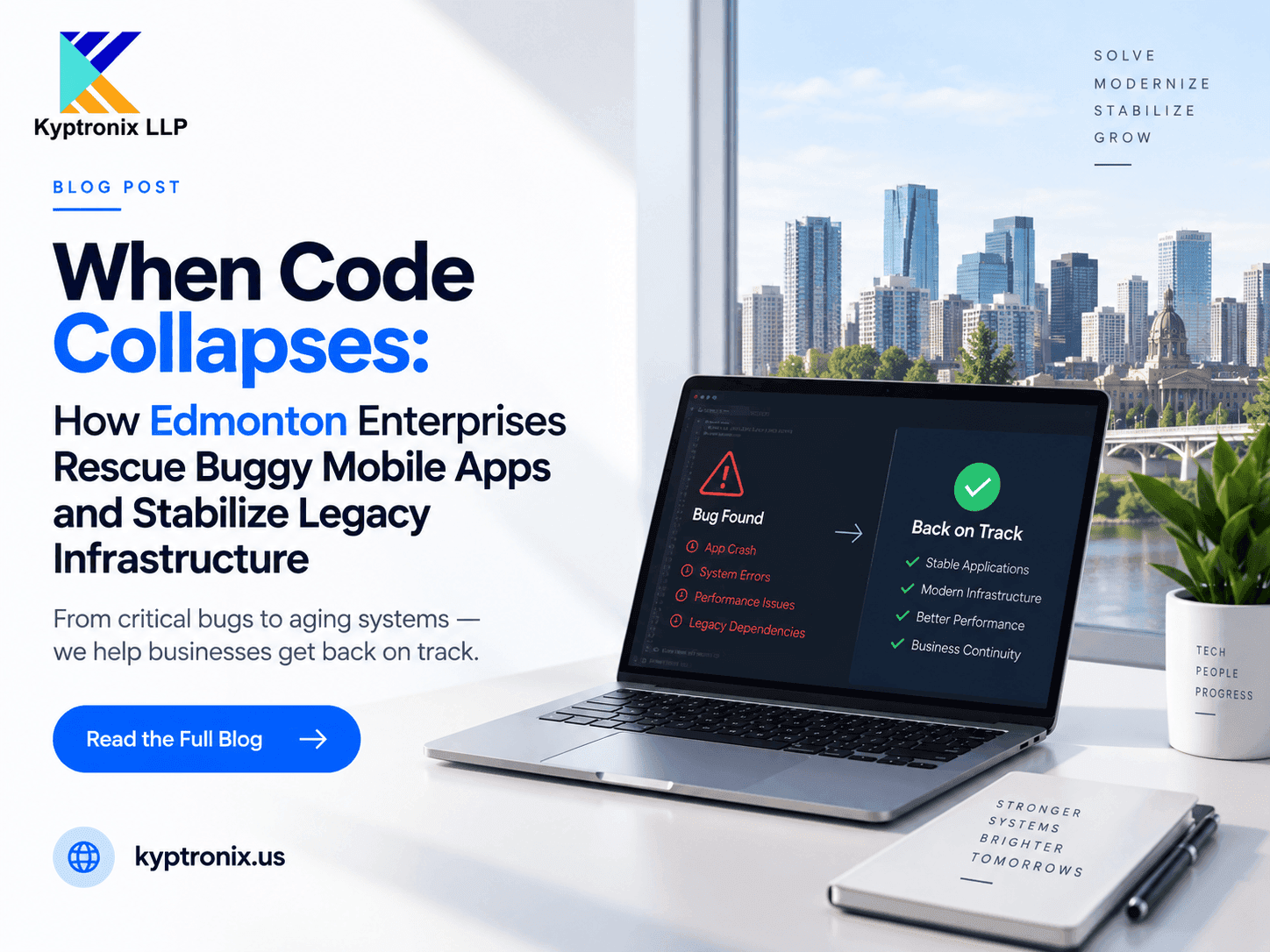
Launching a mobile app is a real financial bet. For a lot of Alberta businesses though, the app that finally ships is the one that freezes under load, crashes without warning, or breaks a little more with every update.
Sometimes that's inherited code from a cheap agency. Sometimes it's a third party framework nobody updated in two years. Sometimes it just never got load tested past a demo. Whatever the cause, the debt piles up quietly until one day it isn't quiet anymore.
At that point patching things one bug at a time stops working. What actually helps is app rescue services Edmonton teams can lean on: someone to audit the mess, fix what's broken, and rebuild what's too brittle to save. That's really what separates a real App Development Company Edmonton businesses can trust from a shop that just adds features on top of a shaky foundation. It takes people who've done legacy code refactoring Alberta projects before, who know how to stabilize a backend without breaking what's already working.
What a Failed Launch Actually Looks Like: An Edmonton Case
After enough of these audits, a pattern becomes obvious. It's almost never one bad line of code. It's usually a handful of small architectural decisions that seemed fine in isolation and turned into a mess together.
Take a field operations app we took over for a logistics provider in Alberta. Crash rate over 14% daily. Database lockouts every morning during peak sync. Memory leaks so bad that field workers were restarting their phones multiple times a shift, just to keep the app usable.
Legacy codebase, full of memory leaks, unindexed SQL, and unhandled errors, going into diagnostic triage (deep static analysis, APM thread profiling), coming out as a refactored system with atomic DB sync, microservices, and CI/CD testing.
A proper mobile application audit, Canada standards would expect turned up three things. Database reads were happening synchronously on the main thread, so any list past a few hundred records just locked the screen. There was no atomic transaction queue for offline work, so data got corrupted every time a driver lost signal on the rougher stretches of Highway 63. And under the hood, the previous agency had left in third-party libraries that were quietly fighting the newer iOS and Android memory management changes.
Fix those three things properly, add real test coverage, and the crash rate dropped to under 0.2% in six weeks. No rewrite needed. Just fixing what was actually wrong instead of guessing.
What Rescue Actually Involves, Beyond the Obvious Fixes
Patching bugs as they come up isn't rescue, it's triage that never ends. Real infrastructure stabilization means going after the structural problems directly, without taking the app offline while you do it.
(Roughly: hotfixes and quick patches sit at high debt but manageable impact. A full architecture overhaul and complete rebuild sit at high debt and high impact, that's the serious end. Routine SDK updates sit at low debt, low impact. Performance tuning and DB indexing sit lower on debt but still move the needle.)
Refactor, or Rebuild?
This is usually the first question that comes up in a crisis, and the answer isn't obvious from the outside.
Rough rule of thumb: once core architectural flaws touch more than about 60% of the codebase, a rebuild using current custom software development Edmonton practices tends to be cheaper in the long run, even though it feels like the bigger swing. Below that threshold, if the logic itself is sound and the pain is really just indexing, rate limits, or leaks, refactoring gets there faster and costs a fraction as much.
Data Privacy Isn't Optional Here Either
Any backend work touching Canadian user data has to satisfy Alberta's PIPA and the federal PIPEDA rules. That's non negotiable: encryption in transit, encryption at rest, no exceptions.
Beyond that, the pipeline itself needs auditing too. Is the infrastructure actually sitting in a compliant Canadian region, AWS Canada Central or Azure Canada East? Are login endpoints enforcing MFA? These are the questions that get skipped when a team is moving fast, and they're exactly the ones that matter.
Keeping Debt From Coming Back
Technical debt compounds. Left alone it just gets more expensive to fix, the same way unpaid interest does. A few things keep it in check long term: wrapping fragile legacy modules in their own containers so one failure doesn't cascade through the whole system, moving blocking database calls into async queues with Redis caching to take pressure off the server, and building a CI/CD pipeline that actually runs security scans and tests before anything reaches production, not after.
How the Rescue Actually Runs, Step by Step
Code audit first: deep static analysis, a real architecture review, using tools like SonarQube alongside APM platforms like Sentry or Datadog to map every leak and slow query.
Then emergency triage: The only goal here is stopping the bleeding, patch the worst crash vectors, update the SDKs that are actively breaking things, stabilize whatever API gateway is closest to falling over.
Then the real work: refactoring the database schema, decoupling the backend from whatever monolith it's stuck in, tuning auto scaling, and bringing the data pipeline in line with Canadian compliance requirements.
Last, the part people skip: automated test suites, a proper CI/CD pipeline, and an SLA that keeps someone watching the system after the "fix" is technically done. Otherwise you're just scheduling the next fire for a year from now.
Ready to Deal With This Properly?
A crashing app costs more than the crashes themselves, it costs trust, and it costs the time your team spends working around a tool that's supposed to help them. Working with a real App Development Company Edmonton team turns that fragile system into something you can actually rely on.
Schedule an App Rescue & Infrastructure Audit with Kyptronix US to get a straight read on your codebase and a realistic plan to fix it.
Frequently Asked Questions
1. What are app rescue services, and when does a business need them?
Diagnosing, refactoring, and stabilizing apps that crash often, perform poorly, or have piled up technical debt and unmaintainable code from previous developers.
2. How do I know whether to refactor my app or rebuild it from scratch?
An audit tells you. Sound core logic usually means refactor. More than 60% of the codebase compromised means a rebuild using custom software development Edmonton standards is probably worth it.
3. What causes mobile apps to crash or freeze in production?
Unhandled network exceptions, main thread database blocking, memory leaks, stale third party SDKs, and background sync that was never optimized.
4. How long does a typical app rescue project take?
Emergency triage: 1 to 2 weeks. Full infrastructure stabilization and refactoring: 4 to 12 weeks, depending on how large the codebase is.
5. How much does app rescue cost in Edmonton?
Depends on complexity and how deep the debt goes. Diagnostic audits usually run $3,500 to $8,000. Full stabilization projects run $15,000 to $60,000, sometimes more.
6. Can Kyptronix take over an app built by another agency or freelancer?
Yes, that's common work for us. Always starts with a full technical audit before we touch anything.